
Art, Chaos, and Structure in Architecture
Introduction: The Architect of the Unspoken
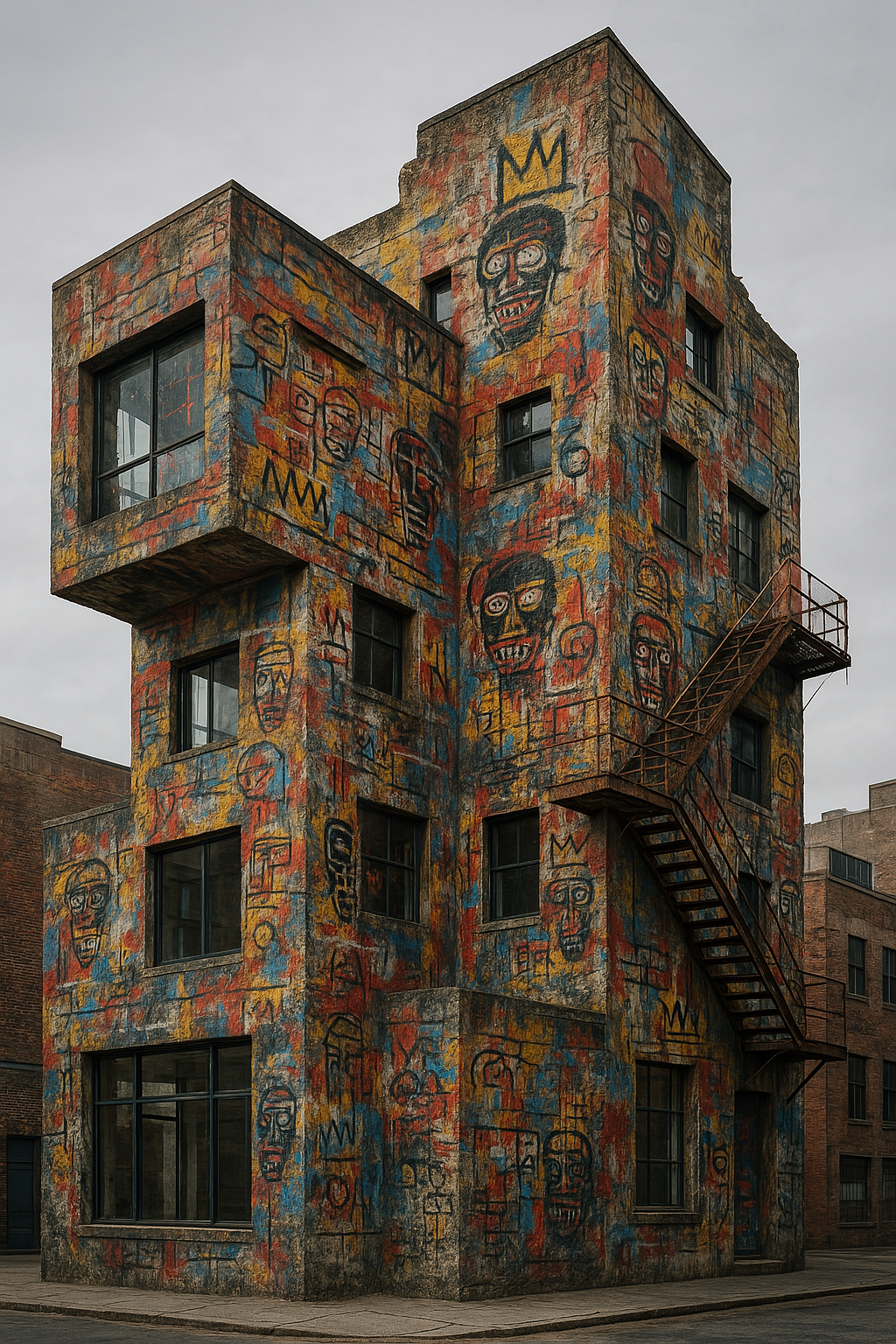
Jean-Michel Basquiat was never meant for containment. His art—frenetic, layered, rebellious—refused the edges of a canvas, bleeding beyond its borders into the cultural psyche. His work was not just seen; it was felt, absorbed, metabolized. If Basquiat had designed a building, it would not have stood in silent obedience to function. It would have spoken—no, shouted—through its walls, murmured through its corridors, whispered through its textures. It would have been a building that did not merely house people but provoked them, unsettled them, made them question the very notion of space, order, and meaning.
To imagine a Basquiat-designed building is to step into an alternate architectural reality, one where chaos is not the opposite of structure but its very foundation. It is to ask: Can a building be jazz? Can it be poetry? Can it break the grid like a defiant stroke of oil stick against a pristine white gallery wall?
The Architectural Language of Basquiat
Basquiat’s paintings were palimpsests of thought—scribbled words, anatomical sketches, erratic marks that oscillated between erasure and revelation. His work bore the urgency of graffiti and the intellect of the avant-garde, a synthesis of high and low culture, history and immediacy, poetry and violence.
His architecture would not adhere to traditional forms. The Vitruvian triad—firmness, commodity, delight—would be shattered and reassembled in unpredictable ways. His buildings would speak in layers: fractured façades exposing raw concrete beneath lavish ornamentation, asymmetrical compositions defying classical balance, materials chosen not for their refinement but for their history, their scars, their ability to narrate.
His walls might be covered in symbols—anatomical sketches blending with fragments of poetry, layers of paint peeling away to reveal the ghosts of earlier iterations. The structure itself might be in a perpetual state of becoming, as if resisting finality, mirroring the unfinished quality of his paintings where meaning was always in flux.
Chaos as Structure, Structure as Chaos
Architecture, at its core, is an act of control—of imposing order upon the world, of defining the limits of space. Basquiat, however, was an artist who thrived in disorder. His work was a rejection of hierarchy, a challenge to authority, an insistence that meaning was not something fixed but something fought over, contested, layered and erased and re-layered.
His building would challenge the modernist obsession with the clean line, the seamless joint, the controlled composition. Instead, it would revel in the raw, the exposed, the incomplete. It would be a building that defied the grid, that disrupted the skyline with jagged, unpredictable forms—cantilevers that jut out like exclamation points, staircases that lead nowhere, walls that seem to bleed their history.
But this chaos would not be random. Just as his paintings had an underlying rhythm—an almost musical syncopation—his architecture would possess a structure that was not immediately apparent but deeply felt. The tension between order and disorder would be its very essence. Like jazz, it would be improvisational yet precise, dissonant yet harmonious, spontaneous yet deeply intentional.
Materiality and the Poetics of the Street
Basquiat was a child of the streets—his aesthetic was born in the alleyways of New York, on subway cars and crumbling walls, in the rhythm of hip-hop and the sharp contrasts of urban life. His building would not be sleek and pristine but raw, textural, tactile.
Concrete, but not polished—rough, scarred, bearing the traces of its making. Glass, but not transparent—distorted, layered, etched with cryptic messages. Steel, but not seamless—corroded, twisted, welded in ways that feel urgent rather than refined.
It would be a building that ages visibly, that absorbs the graffiti of the streets, that invites participation rather than passive admiration. A building that understands that beauty is not in perfection but in the stories a surface tells—the accumulation of time, of history, of use.
The Building as a Manifesto
If Basquiat had designed a building, it would be a manifesto. It would refuse neutrality. It would stand defiantly against the sanitization of urban space, against the erasure of the raw and the real in favor of the smooth and the marketable. It would be a monument not to power but to struggle, not to wealth but to resistance, not to permanence but to the fleeting, electric energy of life itself.
It would be a building that speaks for the unheard, that makes visible what is often ignored. It would be a structure where history is not tidied up and neatly categorized but scrawled in erratic strokes across the walls. It would not be comfortable, but it would be alive.
Conclusion: A Building That Burns
Basquiat once said, “I cross out words so you will see them more.” His architecture would do the same. It would not simply provide shelter—it would demand engagement. It would remind us that architecture is not just about space but about power, about narrative, about who gets to speak and who is silenced.
His building would be a jazz composition in steel and concrete, a poem written in brick and neon, a canvas that never dries. It would not just exist—it would burn. Burn with history, with anger, with joy, with defiance. A building that refuses to be forgotten.
Because if Basquiat had designed a building, it would never simply stand.
It would move. It would breathe. It would scream.
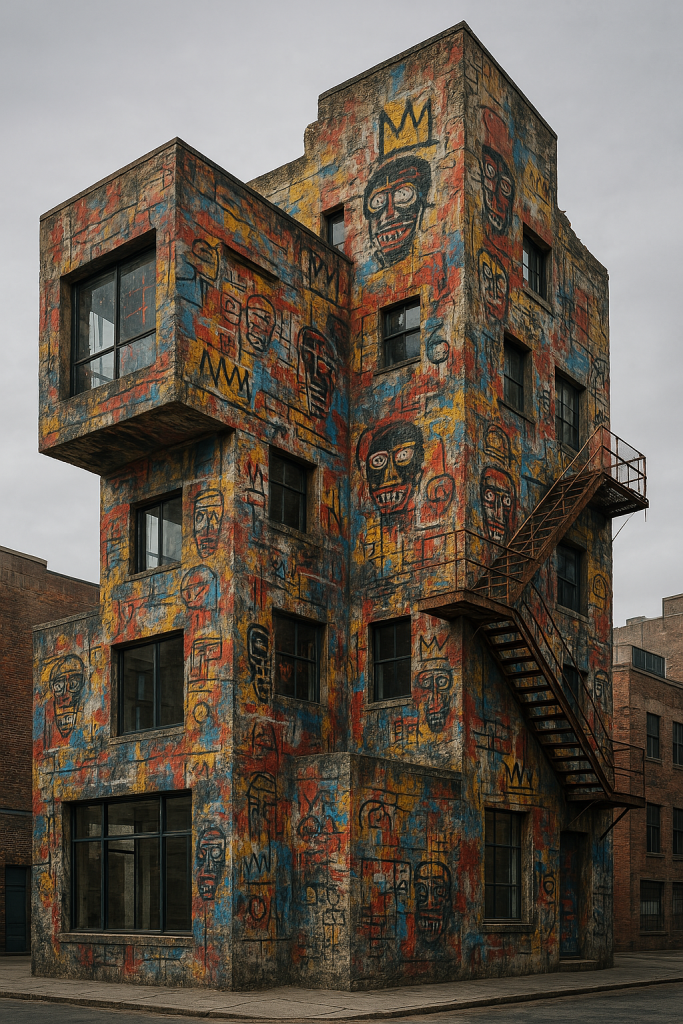
The Basquiat – Mixed use Live Work Artist Retreat
Leave a Reply