By Charles LaVell Scott – MArch., MBA
Abstract:
This article introduces Revitalization of South Broadway, a community-centered design initiative that reframes architecture as a system of cultural memory, economic equity, and intergenerational belonging. Rooted in the material language of Pueblo and Adobe construction, the project uses compressed earth ADUs (Accessory Dwelling Units), life-stage modular housing, and civic economic infrastructure to combat displacement, preserve identity, and foster local resilience. By merging poetic theory with pragmatic urban strategy, the design positions architecture as a living practice of stewardship—a vessel for the stories, lifecycles, and labor of a historically marginalized neighborhood. The South Broadway model demonstrates that revitalization need not mean erasure. Instead, through bioregional materiality, dignified density, and systems of care, architecture can become a mechanism of cultural return.
Introduction: Memory, Erasure, and the Role of Architecture
Across American cities, revitalization has too often meant displacement. Neighborhoods marked as “blighted” are re-coded through the machinery of redevelopment—zoning rewrites, density incentives, and speculative investments—displacing the very people who gave those neighborhoods meaning. This cycle is not accidental. It is designed.
Architecture, in this process, becomes a tool of cultural erasure. Bricks and budgets are poured into sleek facades and commercial corridors, but the embodied histories of families, elders, and small business owners are wiped clean. In South Broadway—like so many historically Black, brown, and working-class corridors—revitalization has come to mean replacement.
But what if architecture could do the opposite?
What if it could serve as a vessel of cultural memory? What if buildings could adapt to the lives of the people who already live there, rather than demand their removal? What if urban design began not with spreadsheets—but with stories?
South Broadway as Case and Catalyst
Revitalization of South Broadway emerges as both a design project and cultural proposition. Located in a corridor rich with Pueblo heritage, working-class resilience, and urban neglect, the project is a multi-scalar response to overlapping crises:
Displacement through gentrification Economic disconnection from local labor Generational disinvestment in place-based identity
Through the lens of architectural stewardship, this project proposes a reversal: rather than designing for extraction, we design for return. Using modular ADUs aligned with lifecycle transitions, site-embedded economic systems, and adobe-inspired material ecologies, this project asks:
What does it mean to stay? What does it mean to be seen? How do we design for belonging, not just occupancy?
Methodology: Life-Stage Architecture and Cultural Materiality
The Revitalization of South Broadway project is grounded in a methodology that combines intergenerational design thinking, cultural material practices, and adaptive economic systems. It reframes urban development not as a top-down intervention, but as a bottom-up choreography of care, calibrated to the lifecycles and livelihoods of those most often left behind.
1. Life-Stage Modular Housing
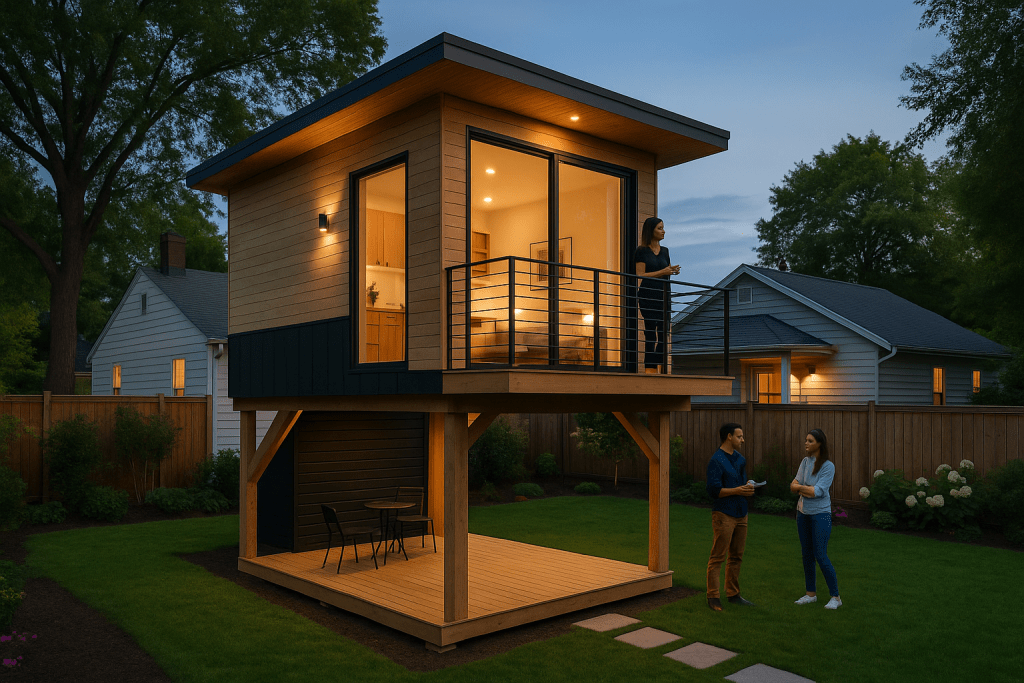
At the heart of the project is a system of modular Accessory Dwelling Units (ADUs) mapped to key life stages:
Student Housing Pods – Compact, affordable, and communal Young Professional Units – Hybrid live/work spaces to support entrepreneurship Family Cores – Expandable multi-room residences with shared courtyards Elder Quarters – ADA-accessible homes integrated with memory gardens and care hubs Ancestor Modules – Sacred space for honoring those who’ve passed, connected to local history walls
This modular typology forms a housing ecosystem, where the architecture ages with the resident, offering dignity, mobility, and continuity.
2. Cultural Materiality and Bioregional Form
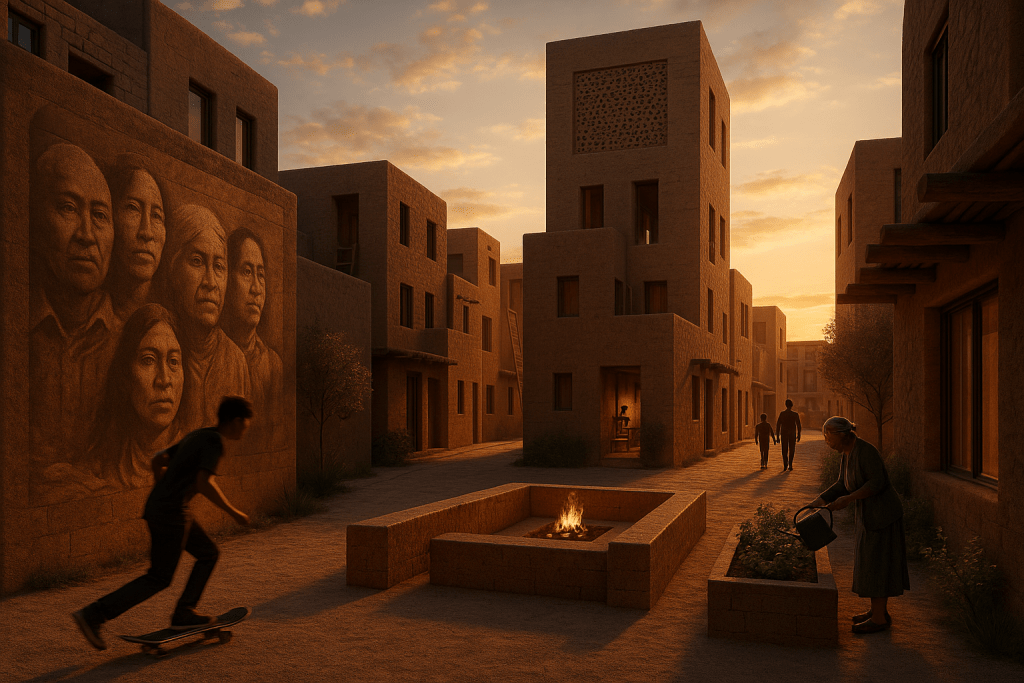
Rather than import standardized construction methods, the project reclaims the use of compressed earth blocks and adobe logic—material systems indigenous to the region’s climate, geography, and ancestral knowledge. This approach:
Reinforces thermal resilience and sustainability Creates structures that feel rooted, not foreign Honors the aesthetic language of the original builders—many of whom were never credited as “architects” but built enduring legacies with their hands and soil
By building from the earth, we also build toward cultural grounding.
3. Adaptive Economic Infrastructure
The South Broadway model integrates economic development into its urban fabric, including:
A new business district node for local vendors, artisans, and family-owned services On-site training and microenterprise incubation within ADUs Embedded food systems and trade-based exchanges (gardens, tool lending, repair workshops)
This transforms each building not only into a shelter—but into a site of income, creativity, and legacy-building.
4. Spatial Justice as Design Principle
The overall site planning resists traditional hierarchies of zoning, and instead follows a rhythm of interdependence:
Elders near children Builders near learners Entrepreneurs near mentors Ancestors in the landscape, not the margins
This methodology centers relational equity as architectural structure.
Architecture as Continuum: Ritual, Return, and Renewal
In many communities, architecture is experienced as a force of interruption—buildings arrive from elsewhere, with agendas and aesthetics detached from the rhythms of local life. But in Revitalization of South Broadway, architecture is reimagined as continuum: a medium through which memory flows, rituals are maintained, and return is made possible.
1. Ritual as Urban Logic
Each component of the site—be it an ADU, a plaza, or a business node—is designed with the rituals of daily life in mind:
Morning light is captured in the elder units’ courtyards for prayer or coffee Communal bread ovens are placed between family and student units to reinforce multigenerational exchange Ancestor walls are placed along walking paths, prompting remembrance, storytelling, and reflection
This is not “placemaking” as trendy activation—it is place remembering, rooted in the sacred cycles of life.
2. Architecture of Return
Rather than displace residents in the name of progress, this project welcomes:
Returning citizens seeking reintegration Children of former residents who left due to lack of opportunity Elders whose families were displaced by speculative development Craftspeople whose knowledge can now become part of the built environment
Through flexible leasing, family land trusts, and design rituals of welcome, South Broadway becomes a site of return—a place where cultural inheritance can be recovered and re-rooted.
3. Renewal Through Design, Not Erasure
In many urban plans, “revitalization” demands that something be removed before something better arrives. This project refutes that logic by proving that:
Beauty does not require gentrification Sustainability does not require displacement Economic development does not require cultural flattening
Instead, renewal is achieved by aligning design with memory. It is not a break—it is a deepening.
Architecture is not the backdrop for culture. It is the vessel through which culture breathes, remembers, and reclaims itself.
Conclusion: Toward an Architecture of Intergenerational Belonging
In South Broadway—as in many corridors of working-class and culturally rich communities—there is no shortage of history. What is often missing is continuity: the ability to remain, to evolve, and to pass on place-based identity without fear of erasure.
Revitalization of South Broadway offers not just a blueprint for development, but a new ethic of design—one that understands architecture as a vehicle for:
Ancestral continuity Economic autonomy Spatial dignity Collective belonging
By grounding housing in life stages, materials in bioregional history, and spaces in cultural ritual, this model offers a non-displacing urbanism that does more than preserve the past—it equips the future.
A New Role for Architects and Planners
The designer here is not a stylist or savior. They are:
A steward of memory A cartographer of invisible economies A facilitator of cultural return
Architecture becomes not an act of authorship, but of listening and amplification.
Reclaiming the Meaning of Revitalization
Revitalization does not require starting over. It requires starting deeper.
Through this project, we see how the tools of design—when attuned to culture, care, and kinship—can build places not just to live, but to belong across generations.
To revitalize South Broadway is to restore its soul—not by overwriting its past, but by letting its people shape its future, brick by brick, memory by memory.
Leave a Reply