Abstract:
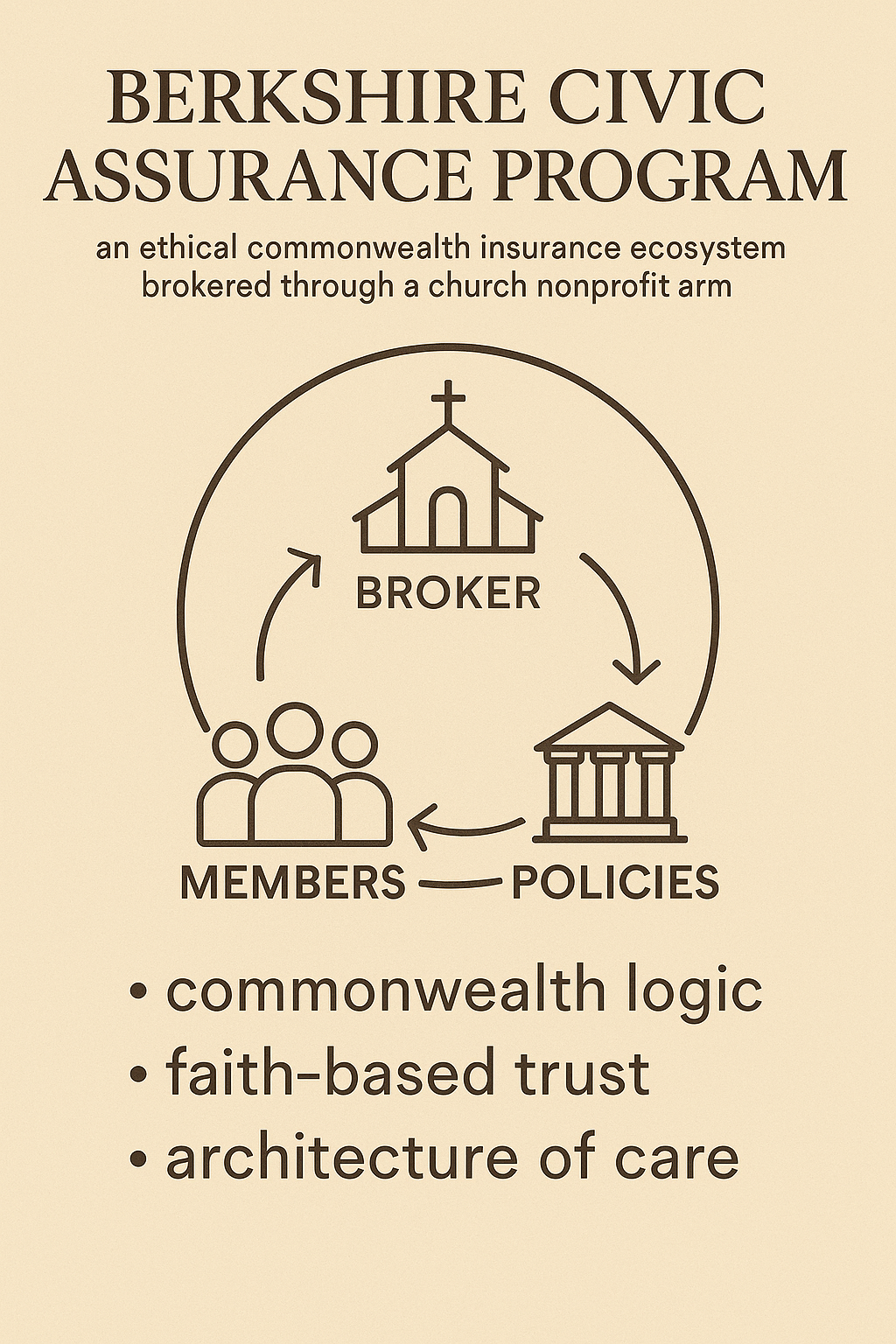
This article explores a radical reframing of insurance as civic architecture through the creation of a nonprofit, faith-aligned brokerage system operated by Birkshire Church under The LaVeL Group. Positioned as a commonwealth model for collective security, this initiative connects underserved members—artists, workers, elders, and returning citizens—to corporate insurance policies typically inaccessible due to economic or structural exclusion. Rather than viewing insurance as a transactional industry, the project reframes it as a ritual of belonging, a spiritual act of protection, and a new form of architectural covenant. By integrating policy literacy, communal risk pooling, and ritualized onboarding into physical civic centers, the program becomes a hybrid of public utility, ethical infrastructure, and spiritual service. This article proposes that when we root risk and care in faith and community, we can regenerate systems that are currently predatory, extractive, and dehumanizing. Shield as Covenant is not just a policy—it is a model for post-capitalist spiritual infrastructure.
Introduction: The Predatory Logic of Protection
In the modern United States, insurance is a paradox. It promises safety, but often functions as a gatekeeper. It claims to manage risk, but routinely amplifies vulnerability—especially for those already marginalized by income, race, health status, or employment precarity. As premiums rise and coverage narrows, millions find themselves navigating a system that is structurally opaque, economically predatory, and spiritually hollow.
Yet what is insurance, at its core, if not a covenant of care?
At its best, it is a shared agreement: a promise that if you fall, you will not fall alone. That your health, your livelihood, your children, your home, your passing—will be held. That there is a social body strong enough to catch you.
But in a culture where individualism reigns, insurance has mutated from covenant to commodity. It no longer functions as a reflection of communal interdependence, but as a fragmented and extractive market—one that rewards actuarial avoidance over collective stewardship.
Reimagining Insurance as Infrastructure
This paper introduces a bold, faith-rooted alternative: a nonprofit insurance brokerage ecosystem designed as a form of civic service architecture. Operated by Birkshire Church, a civic-faith division of The LaVell Group, the program will provide access to group-rated insurance policies for all participating members, with services embedded in architectural spaces of learning, dignity, and spiritual grounding.
Rather than centering profit, this model centers:
Commonwealth economics Ritual-based enrollment Policy literacy as sacred stewardship And a reintroduction of trust through architectural experience.
What if signing up for a policy felt like joining a village, not entering a contract?
What if the place where you received your health insurance also taught financial sovereignty, fed you, and prayed with you?
This is not utopian idealism. It is post-capitalist spiritual realism—a reframing of infrastructure as both social and sacred.
Methodology: Covenant Economics and Architectural Grounding
The design and delivery of this nonprofit insurance program emerges from a hybrid methodology that blends faith-based service logic, commonwealth economic principles, and architectural systems thinking. It draws from scripture, sociology, and real estate development with equal weight—seeking not merely to broker policy, but to rebuild the spiritual and structural foundations of mutual care.
1. Faith as Civic Function
Birkshire Church, the spiritual and nonprofit arm of The LaVell Group, provides the moral and legal anchor for this initiative. It does not operate as a doctrinal ministry, but as a civic-faith architecture: a platform for ritual, trust, and restorative economics. The church functions as a:
501(c)(3) legal wrapper for a nonprofit insurance brokerage Spiritual warrant for communal protection and transparency Architectural host for literacy labs, policy onboarding, and covenant ceremonies
This methodology positions faith not as exclusionary belief, but as infrastructure for belonging.
2. Commonwealth Model of Insurance
Inspired by mutual aid networks, fraternal orders, and tribal kinship systems, the Birkshire program replaces actuarial avoidance with covenant economics:
All members gain access to health, life, disability, and property insurance at negotiated group rates Policies are brokered through existing licensed providers, but distributed via a community-first platform Monthly member dues or donations help cover uninsured hardship and legal literacy programming Financial surplus is reinvested into civic wellness—not executive profit
This model is not insurance-as-market—it is insurance-as-inheritance.
3. Architecture as Sacred Interface
The physical spaces that support this program are not offices—they are ritual architectures:
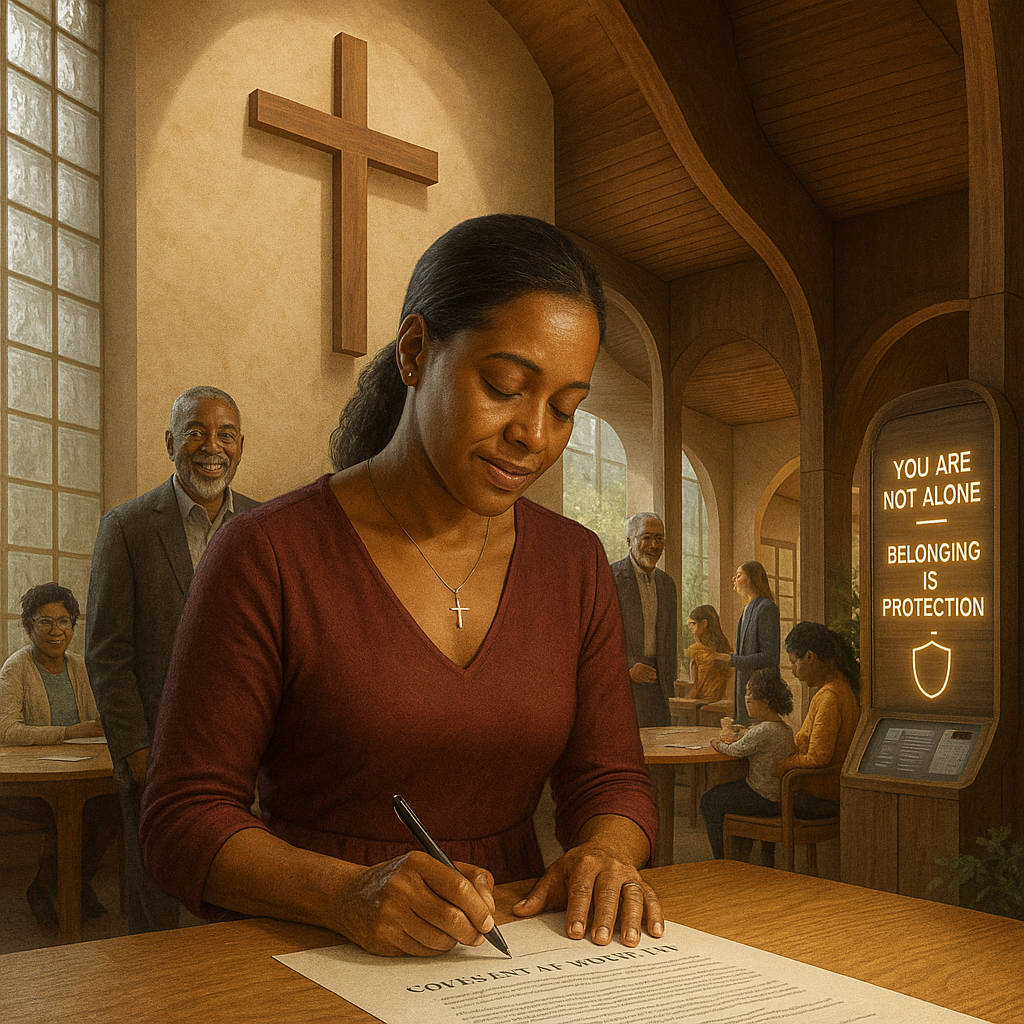
The Commons Engine or Birkshire chapels become the onboarding spaces for new members Policy literacy workshops are hosted weekly in accessible spaces with food, translation, and digital access Sign-up ceremonies replace transactional enrollment, where a member signs their covenant with support and intention Memorial services, family milestones, and generational planning are hosted under the same roof—making protection visible, communal, and intergenerational
This spatial integration ensures the program is not abstracted—it is seen, felt, and inhabited.
4. Grounding in Law and Ethics
The model operates entirely within legal bounds:
All insurance policies are underwritten by licensed corporate providers Birkshire acts as a nonprofit broker, not an insurer The church status ensures religious freedom of operation, while the civic framing guarantees equitable outreach Ethical guidelines prevent coercion, exploitation, or denial based on health or income status
By blending ancient spiritual logic with modern compliance infrastructure, this methodology allows the program to scale with integrity.
The Spatial Logic of Protection: From Risk to Ritual
Contemporary insurance is experienced almost entirely through digital interfaces and legal jargon. It is abstract, impersonal, and inaccessible by design. The Birkshire Civic Assurance Program seeks to invert that experience—by making protection not only visible and tangible, but ritualized and spatially embodied.
This approach treats insurance not merely as a policy—but as a public sacrament. A shared structure of holding that takes architectural form.
1. From Signatures to Sacred Commitments
Enrollment begins not with a form, but with a covenant ceremony:
Held in a chapel, co-op, or civic node like The Commons Engine Framed as a moment of intentional commitment, not transactional obligation Accompanied by explanation, literacy, and community witnessing
This transforms the act of being insured from a private risk hedge into a public acknowledgment of interdependence.
2. Embedded Architecture for Trust
The Birkshire program is spatially embedded in a network of sacred-civic spaces:
Wellness rooms, digital equity zones, grief circles, and administrative naves Childcare and meal access during enrollment appointments Garden walkways and meditation spaces alongside insurance kiosks Access to policy coaches and legal guides in ritual-attuned environments
This architecture makes the invisible social contract visible and sacred. Risk is no longer outsourced to actuarial tables—it is held in space.
3. Materiality of Dignity
The spatial language of the program resists austerity and bureaucracy:
Materials include earth block, bamboo, wool felt, and glass block for light diffusion Forms are curved, open, and ritual-compatible Signage speaks in plain language and poetic metaphors: “You are not alone.” “This is your shield.” “Belonging is protection.”
This material and visual lexicon aligns dignity with functionality. It communicates: you matter. This is yours.
4. Policy Literacy as Empowerment
Workshops are held weekly—like sermons or healing circles:
What is life insurance? How does disability coverage work? How do wills, trusts, and long-term care planning unfold? Who profits in your current policy—and what does a non-extractive alternative look like?
By embedding education inside architecture, literacy becomes a form of sanctuary.
The architecture of protection is not walls and locks—it is presence, clarity, and the sacred repetition of communal care.
Covenantal Infrastructure and the Post-Capitalist Faith Economy
We are entering an era of collapse and awakening. Institutions built on extraction, privatization, and algorithmic control are rapidly losing public trust. But in that void, a new form of infrastructure is emerging—one that draws power not from surveillance or scarcity, but from ritual, trust, and collective belonging.
The Birkshire Civic Assurance Program is not just an alternative insurance model—it is a prototype for a post-capitalist faith economy: an ecosystem of care, structured like a covenant, embodied in architecture, and animated by collective dignity.
1. Faith Without Dogma, Capital Without Predation
This model refuses the binary between:
Religious exclusivity and secular alienation State bureaucracy and private exploitation
It offers a third path—civic-faith architecture—where spiritual values (belonging, reciprocity, memory, protection) are made operational through:
Nonprofit brokerage Cooperative risk models Ritualized onboarding Architectures of inclusion
Here, faith is not belief—it is a practice of mutual responsibility.
2. Insurance as Architecture of Moral Economy
What if insurance wasn’t profit-first, but care-first?
What if your premium funded:
Your neighbor’s surgery Your child’s grief counseling A garden for someone you will never meet?
What if your policy came with a space to sit, to learn, to mourn, to plan?
This model frames insurance as spatial ethics—a built commitment to not leave each other behind.
3. Scalable, Sacred, and Legally Sound
The Birkshire model can be adapted to:
Housing cooperatives Worker collectives Neighborhood trusts Diasporic and interfaith networks
Because it operates as a nonprofit broker, not an insurer, and is wrapped within legally compliant religious infrastructure, it has both the spiritual depth and institutional flexibility to scale ethically.
4. A Living Covenant
In the end, this is not just a policy framework—it is an architecture of promise.
It asks:
Can trust be designed? Can protection be sacred? Can infrastructure speak the language of care?
The answer, offered by this work, is yes.
The covenant is alive. And it is ours to build.
Leave a Reply