By Charles LaVell Scott – MArch., MBA
Abstract
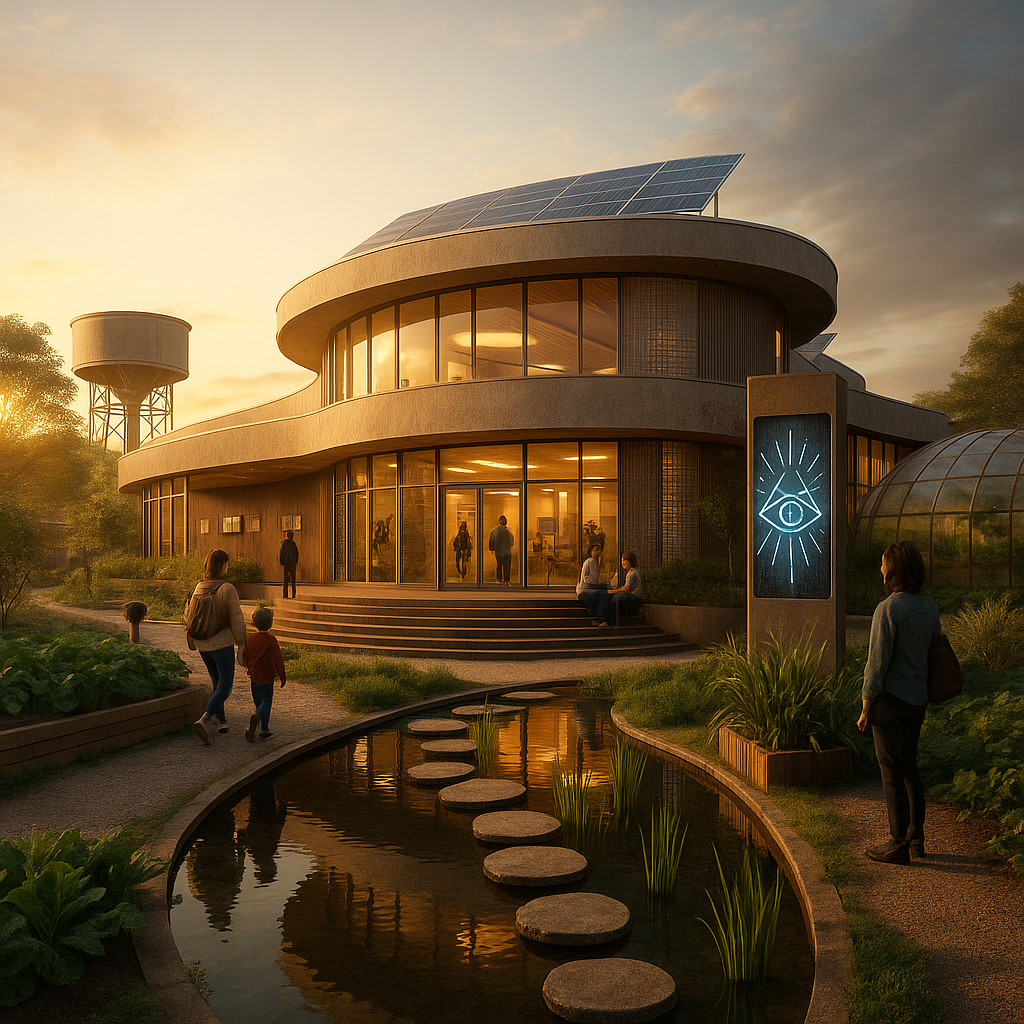
The Commons Engine is a visionary civic typology that reimagines public infrastructure as a living system of emotional, ecological, and cultural healing. In response to rising ecological collapse, civic disconnection, and collective trauma, this architectural prototype combines mental health sanctuaries, food sovereignty networks, decentralized utility control, and memory-driven cultural spaces into a singular spatial organism. This article explores The Commons Engine not only as a design proposal, but as a new model for public architecture—where trauma is metabolized into trust, where energy flows with transparency, and where civic space functions as sacred ground. Bridging ritual, technology, and cooperative urbanism, The Commons Engine proposes a radical expansion of what public architecture must do in the Anthropocene.
Introduction: The Collapse of the Civic Imagination
We are living in a time of overlapping failures.
Public trust in institutions has eroded. Civic infrastructure, once imagined as the skeletal framework of democratic life, now functions primarily as an instrument of surveillance, control, or abandonment. In many cities, the “commons” has either been privatized or rendered inert—leaving behind fragmented communities and emotionally bankrupt spaces.
Meanwhile, the urban landscape reflects this trauma. Our buildings are optimized for transaction, not transformation. Our parks are beautified but spiritually empty. Our libraries are underfunded, our mental health facilities overburdened, and our town halls reduced to procedural theaters. What remains is a profound disconnect between people and place, infrastructure and intimacy.
The pandemic era magnified what was already visible: the absence of civic spaces that nourish, restore, and belong to the people. What is needed now is not another civic complex or service kiosk—but a new architectural ethos—one that understands the nervous system of the city as sacred, social, and ecological.
The Commons Engine emerges from this void—not as a building in the conventional sense, but as a ritual infrastructure.
It is a prototype for a new kind of public utility: one that powers trust, feeds communities, archives culture, and converts grief into growth.
This article outlines the architectural, philosophical, and social logic of The Commons Engine, positioning it as a scalable model for post-trauma urbanism, emotional sustainability, and the re-sacralization of the commons.
Methodology: Designing for Collective Repair
A Systems-Based Ritual Architecture
The design of The Commons Engine is neither driven by aesthetics nor formalism—it is driven by function, ritual, and systems coherence. It begins with a simple question:
What does a community need in order to heal?
And then it asks:
What spatial conditions can make that healing possible, visible, and replicable?
This project draws upon multiple interdisciplinary threads:
Trauma studies and somatic psychology Urban ecology and regenerative infrastructure Ritual theory and sacred space design Decentralized energy and water system models Indigenous knowledge systems and cooperative governance
These inputs converge into a design methodology that is functionally systemic and symbolically sacred.

The Five Pillars of the Commons Engine
The spatial and programmatic framework is built around five interwoven domains:
1. Emotional Infrastructure: The Oracle Core
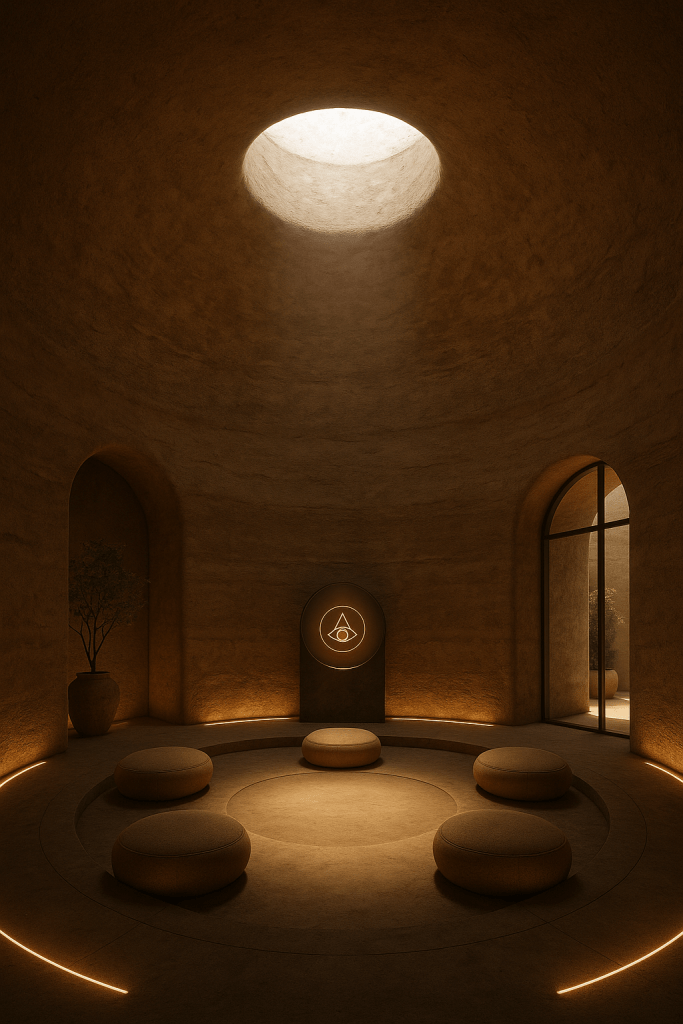
Quiet chambers designed for emotional release, reflection, and guided healing.
Breath-responsive lighting and acoustics AI-supported reflection nodes (“Oracles”) Grief garden and stillness corridors This zone treats mental wellness as public infrastructure—not private pathology.
2. Nourishment Infrastructure: The Food Forest Nexus
Communal kitchen and fermentation lab Medicinal herb garden and edible landscape Teaching zone for intergenerational culinary practices This transforms food from commodity to community ritual.
3. Resource Infrastructure: Energy + Water Spine
Transparent microgrid control center Rainwater harvesting and water memory fountain Passive heating/cooling galleries By making utilities visible and interactive, this zone turns consumption into consciousness.
4. Cultural Infrastructure: The Memory Archive
Story walls and media pods for oral history Sound dome for collective listening and performance Library of forgotten practices This zone restores lost knowledge and makes identity a spatial asset.
5. Civic Infrastructure: The Democratic Threshold
Public assembly zones for council, protest, and ritualized governance Mapping walls of ecological grief and urban renewal Digital equity node + tech library This zone invites decision-making, activism, and equity into the architectural core.
Design Process and Spatial Language
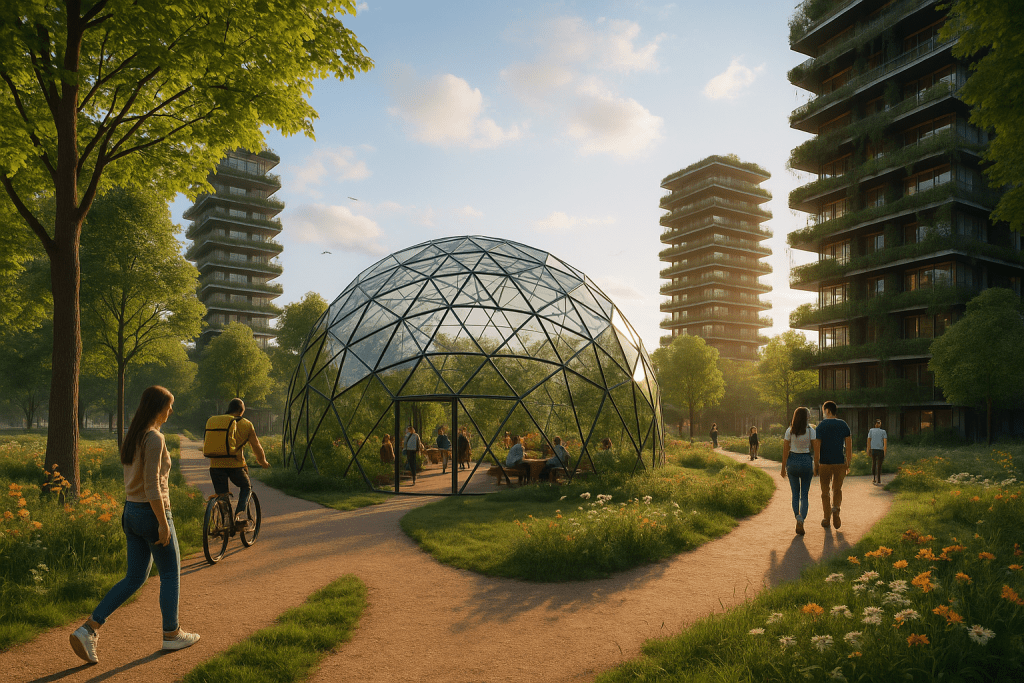
The Commons Engine is organized around a central solar corridor, flanked by zones that move from interior stillness to outward action. The journey through the space is metaphoric and functional:
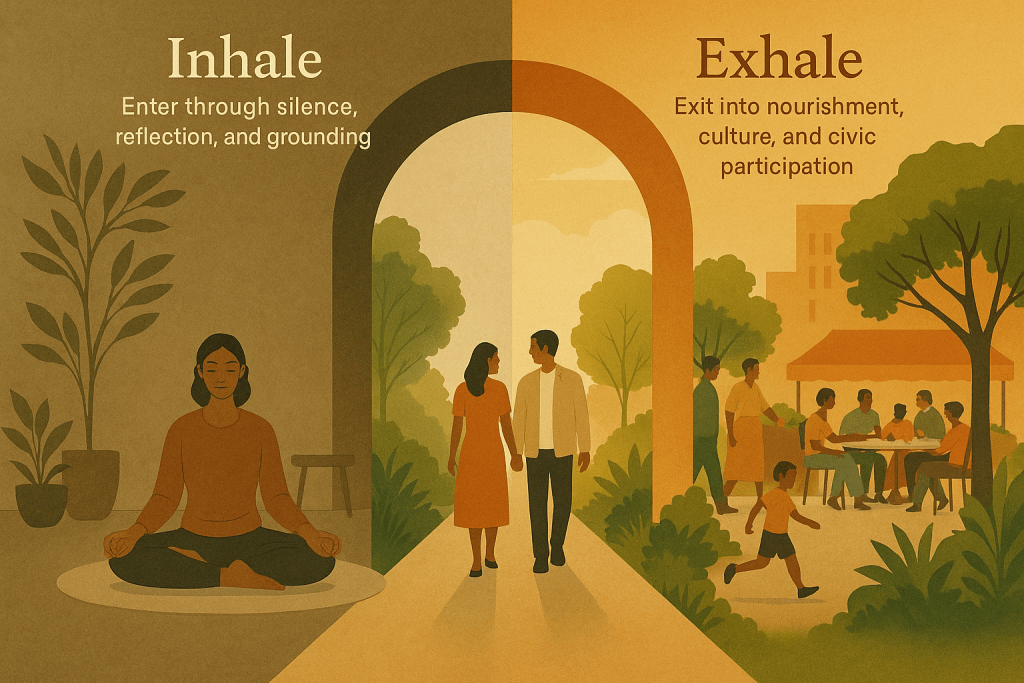
Inhale: Enter through silence, reflection, and grounding Exhale: Exit into nourishment, culture, and civic participation

Material selection is grounded in bioregional logic:
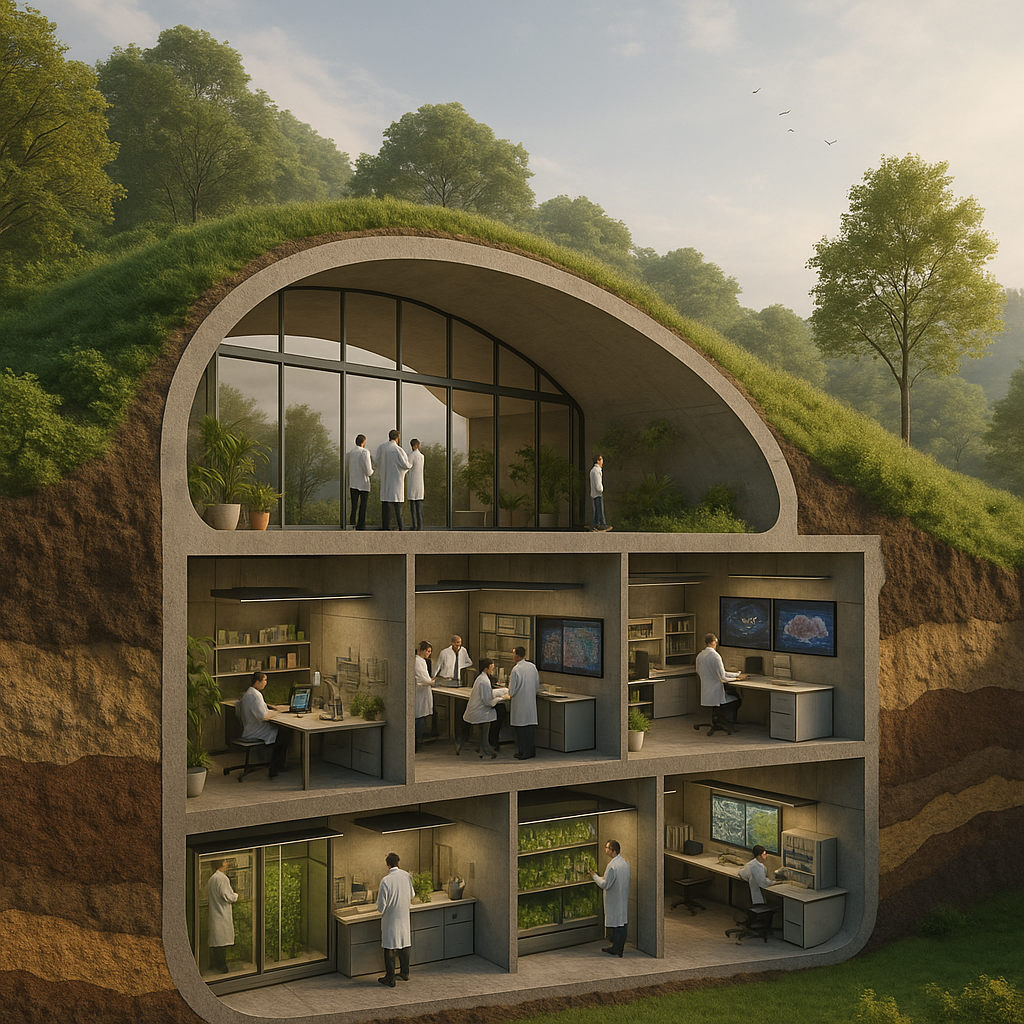
Earthen plasters and rammed earth walls (emotional grounding) Timber + carbon-negative cladding (regenerative materiality) Translucent solar glass and hydromorphic systems (ritualized light and flow)
The structure becomes an organism, not a container. A commons, not a facility.
The Commons Engine as Civic Ritual Machine
Architecture has long served ceremony—from cathedrals to courthouses. But modern civic design has increasingly become antiseptic, procedural, and emotionally neutral. The Commons Engine restores ritual as a design tool—not through spectacle or nostalgia, but through spatial sequence, sensorial cues, and communal intentionality.
1. Threshold as Transformation
Upon entry, the visitor passes through a wind corridor—a compressed passage where air moves with subtle sound. This acts as a physiological signal: “You are crossing into a space of intention.”
The ceiling lowers, the light dims, and the acoustic texture shifts. The space slows you down—a collective exhale.
2. Oracle Core: The Inward Spiral
The first spatial node is the Oracle Chamber—a series of quiet domes and reflective chambers:
Each tuned with responsive light and sound to match breath rhythm Each private yet porous, allowing the presence of others to be felt Facilitated by AI companions, these nodes become digital confessionals, pattern recognizers, or silent friends
This zone is not for performance—it is for release. It dignifies the emotional labor of being human.
3. Food Forest: Ritual of the Everyday
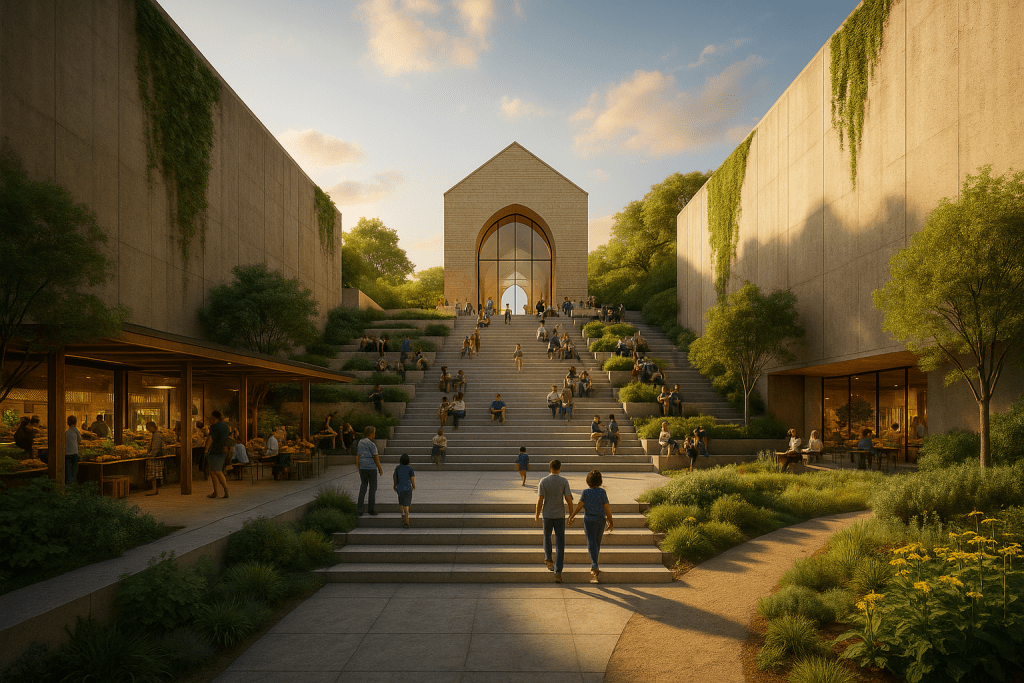
As users move outward, they encounter a sunlit courtyard of edible landscapes and a communal kitchen:
A fermentation wall displays ancient food processes A long stone table anchors meals, teachings, and ceremonies Culinary rituals become central—not peripheral—to civic identity
This zone embodies the idea that to nourish together is to govern together.
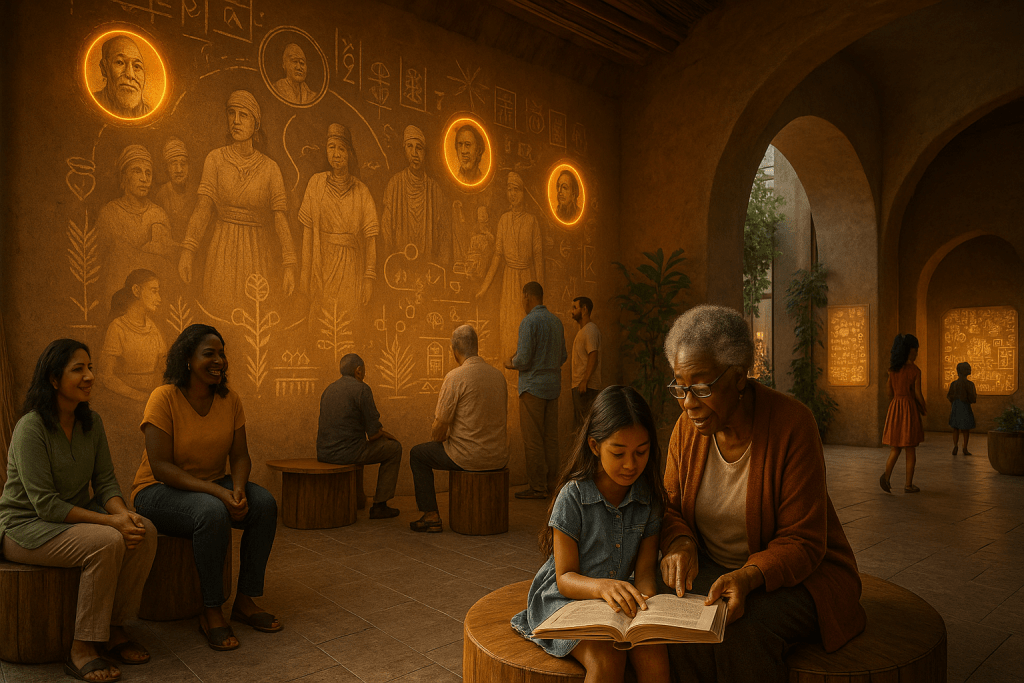
4. Cultural Archive: Listening as Justice
Along the north wing, visitors walk beside a wall of stories—visual, sonic, tactile:
Rotating oral histories of grief, resilience, and joy Interactive murals and sound domes Workshops for ancestral crafts and cultural technology
Here, the building becomes a living archive, capable of hearing, not just showing.
5. The Civic Front: Radical Belonging
At the far end of the complex lies an open plaza—not a closed hall.
Here, residents vote, protest, grieve, celebrate, or simply gather.
A ritual map on the plaza wall marks sites of ecological loss and repair—a living ledger of collective responsibility.
This is not civic architecture for the state.
This is civic architecture for the soul.
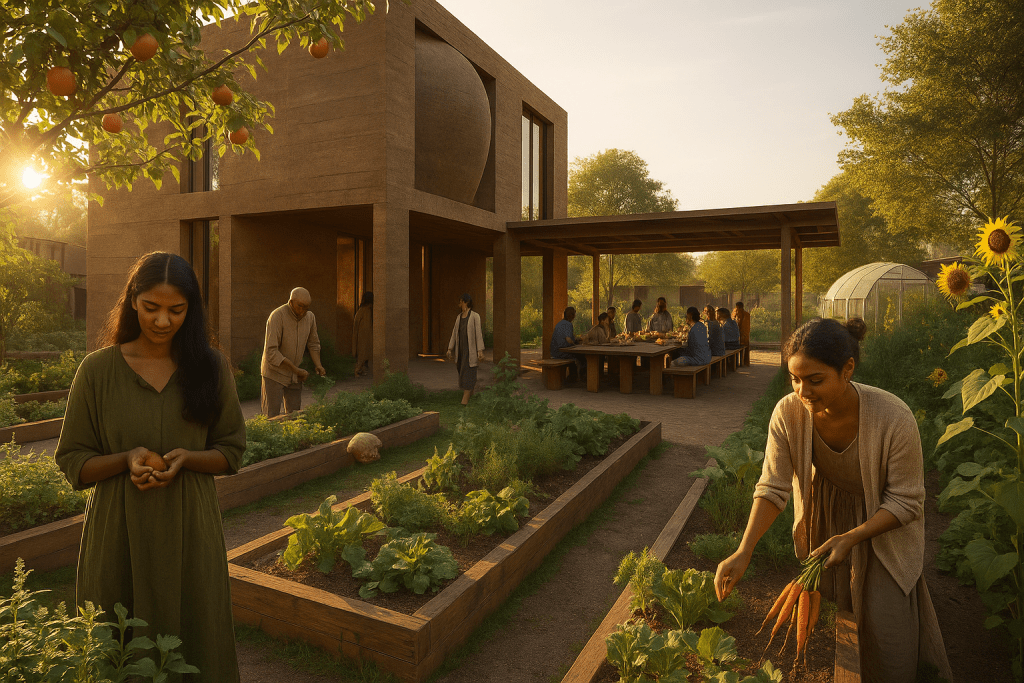
Together, these zones compose a ritual engine—an infrastructural organism that metabolizes trauma into community trust, and isolation into interdependence.
Toward a Post-Trauma Urbanism
Modern cities have mastered the infrastructure of efficiency.
What they lack is the infrastructure of healing.
From COVID-era isolation to climate displacement to racialized violence and economic precarity, the city today is saturated with unprocessed trauma—personal, communal, and planetary. And yet, the spaces we designate as “public” rarely acknowledge this. We build libraries, parks, and plazas without asking the most urgent civic questions:
Where do people go to cry in public? Where is grief processed collectively, not alone? Where is nourishment available not just as charity, but as ritual? Where can the public witness its own becoming?

The Commons Engine as Blueprint
The Commons Engine is not a finished building—it is a template.
Its design logic can be replicated across cities, towns, and even digital or nomadic platforms. Its core principles include:
Transparent utilities as education Emotional architecture as baseline, not luxury Cultural storytelling embedded into infrastructure Ritualized, equity-first civic spaces
Wherever trauma has ruptured place and people, this model offers integration without erasure, ritual without dogma, and repair without surveillance.
Designing for Dignity and Continuity
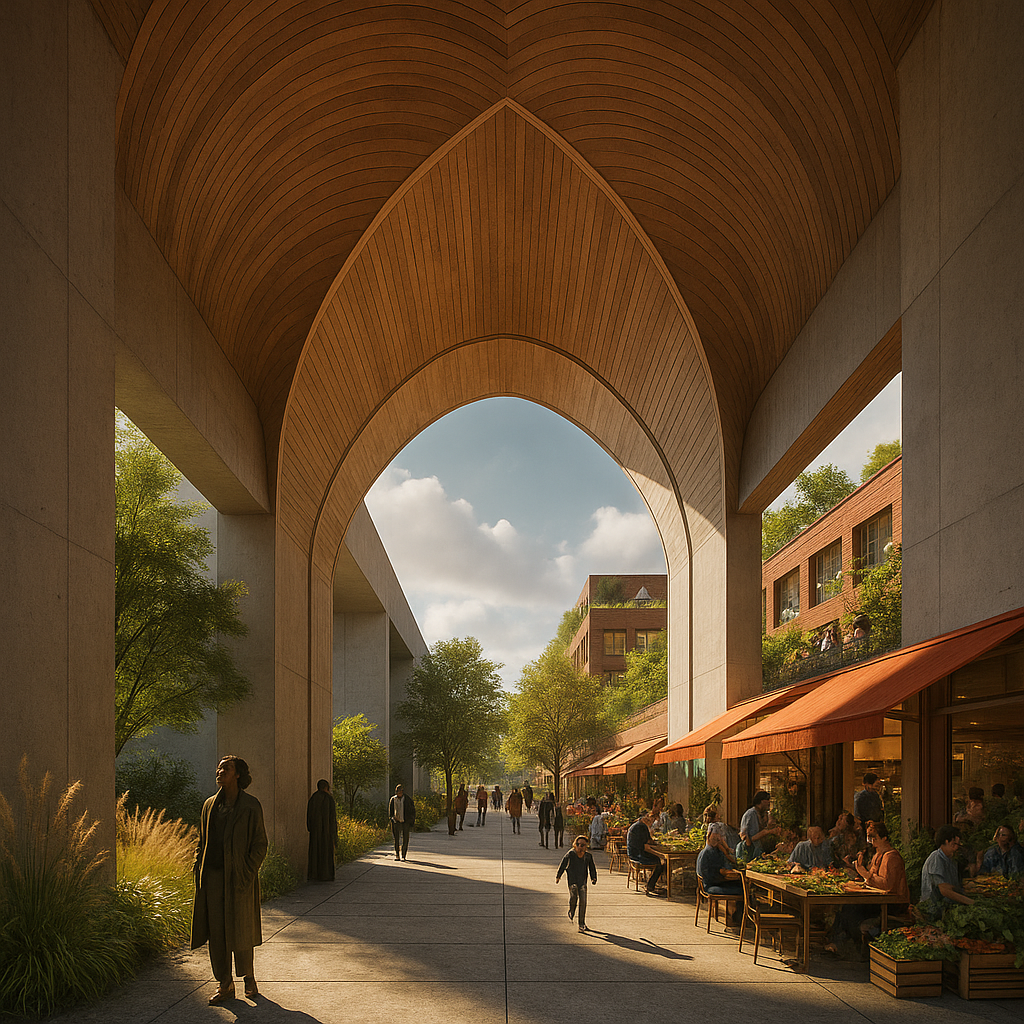
In contrast to the extractive architecture of efficiency, The Commons Engine imagines a continuity of care, across:
Emotional systems Ecological flows Civic trust Cultural inheritance.
It is an invitation to reimagine public space as sacred utility—an infrastructure that doesn’t just support life, but restores it.
Conclusion: From Utility to Belonging
The Commons Engine is a proposition:
That architecture can metabolize grief.
That infrastructure can cultivate joy.
That civic space can be soft, sacred, and self-aware.
We must build not only for shelter, commerce, or access—but for emergence, transformation, and coherence. In an age of collapse, The Commons Engine is not a solution. It is a ceremony for beginning again.
Leave a Reply