
Charles LaVell Scott – MArch, MBA

Abstract
This paper introduces the Kinetic Sail Generator, a novel bio-responsive energy system that integrates flexible photovoltaic textiles with kinetic micro-generator seams. Designed as a modular, deployable membrane, the invention functions across land, sea, and aerial surfaces, transforming sails, rooftops, and open water into responsive power sources. Drawing from biomimetic design principles and decentralized energy theory, the system reimagines energy infrastructure as soft, adaptive, and architecturally integrated. Its multilayered design includes energy storage nodes, motion-harvesting seams, and solar-reactive fabrics, forming a lightweight and scalable platform capable of powering devices, structures, or entire microgrids. This work positions the Kinetic Sail Generator as a prototype of “living infrastructure”—a new typology of energy skin that evolves with its environment.
Introduction
As the global climate crisis intensifies and centralized energy grids face increasing vulnerability, the future of power generation must become both decentralized and adaptive. Traditional solar and wind technologies, though effective, often remain rigid, bulky, and contextually intrusive. They require fixed surfaces, controlled environments, and significant installation infrastructure—constraints that are incompatible with nomadic, off-grid, or disaster-prone settings.
This paper proposes an alternative: a kinetic, quilted membrane capable of harvesting energy from its own motion and solar exposure. Inspired by biological skins, sail membranes, and distributed sensor networks, the Kinetic Sail Generator transforms the idea of infrastructure into something breathable, modular, and alive. It is not a machine, but a surface—a fabric that collects, stores, and distributes energy while conforming to architecture, landscape, or ocean.
At the intersection of material science, architecture, and energy design, this invention introduces a new paradigm: energy skins as both aesthetic and functional layers of civilization. The Kinetic Sail Generator is a proof-of-concept for how future infrastructures might look, feel, and behave—not as towers of extraction, but as adaptive extensions of natural motion and sunlight.
2. Theoretical Foundation
The Kinetic Sail Generator arises at the confluence of biomimetic design, adaptive architecture, and the global need for distributed, resilient energy systems. Each of these domains challenges traditional notions of infrastructure by asking how we might design systems that move with the world, rather than resist it.
2.1 Biomimicry and Responsive Materials
Biomimicry, as articulated by Janine Benyus and further developed by sustainable design theorists, suggests that nature offers templates for efficiency, adaptability, and elegance. Organisms such as jellyfish, kelp, bird wings, and mycelial networks collect and transmit energy fluidly, without rigidity or centralized control. The kinetic sail draws from this logic—emulating the dynamic skin tension of living bodies, where form and function are inseparable.
Rather than building stiff, singular-purpose objects, the sail proposes a distributed, modular energy fabric that conforms to movement and changing light. The use of quilted photovoltaic patches and flexion-reactive seams mirrors biological membranes that both protect and metabolize. The result is not simply an energy device, but a form of synthetic epidermis that powers, breathes, and adapts.
2.2 Adaptive Architecture and Non-Static Infrastructures
Contemporary architecture, long obsessed with permanence and solidity, is beginning to evolve toward flexibility, deployability, and sensory awareness. Pioneers such as Cedric Price, Frei Otto, and Neri Oxman have theorized and built architectures that move, grow, or interface with their environments like living systems.
The Kinetic Sail Generator aligns with this evolution, presenting an architecture that is not a building, but a process—a spatial and energetic skin that can wrap, sprawl, or rise. Its application as a façade, roof, or marine surface reinforces architecture’s shift from object to organism, from structure to system.
In doing so, it contributes to the vision of “living infrastructure”: not infrastructure imposed upon nature, but one that harmonizes with wind, sun, water, and entropy.
2.3 Decentralized Energy Theory
Traditional energy systems rely on centralized generation and hierarchical distribution, which create bottlenecks, vulnerability, and geopolitical fragility. In contrast, distributed systems—especially those embedded in buildings or mobile surfaces—offer resilience, redundancy, and community-level autonomy.
The sail generator proposes a radically decentralized model: each patch and seam is an energy node; each deployment is a microgrid. This modularity makes it ideal for use in off-grid environments, disaster zones, nomadic installations, and future space habitats. Its design philosophy mirrors that of blockchain and neural networks: strength through redundancy, adaptability, and distribution.
Summary
The Kinetic Sail Generator is more than a product—it is an architectural theory, a material philosophy, and an ecological ethic woven into one. It asks not only how we power the future, but what it looks like, how it moves, and what it says about our place in the natural order.
3. System Description
The Kinetic Sail Generator is a modular, multifunctional energy system composed of four interlinked components: flexible photovoltaic patches, kinetic seam generators, micro-storage nodes, and deployment architecture. Together, these form a dynamic energy skin capable of harvesting, storing, and distributing electricity across a wide range of surfaces and environmental conditions.
3.1 Photovoltaic Quilt Modules
At the core of the system is a flexible membrane made of textile-based photovoltaic film, sewn or laminated into quilt-like patches. Each patch acts as an independent solar energy collector, optimized for lightweight deployment and ambient-angle efficiency.
These patches are:
- Semi-permeable, allowing airflow and breathability
- Rollable or foldable, making them ideal for transport and field deployment
- Designed for modular replacement, ensuring repairability and longevity
The quilt metaphor is functional as well as symbolic—it represents a network of autonomous yet cooperative energy cells stitched together into a shared surface.
3.2 Seam-Based Kinetic Micro-Generators
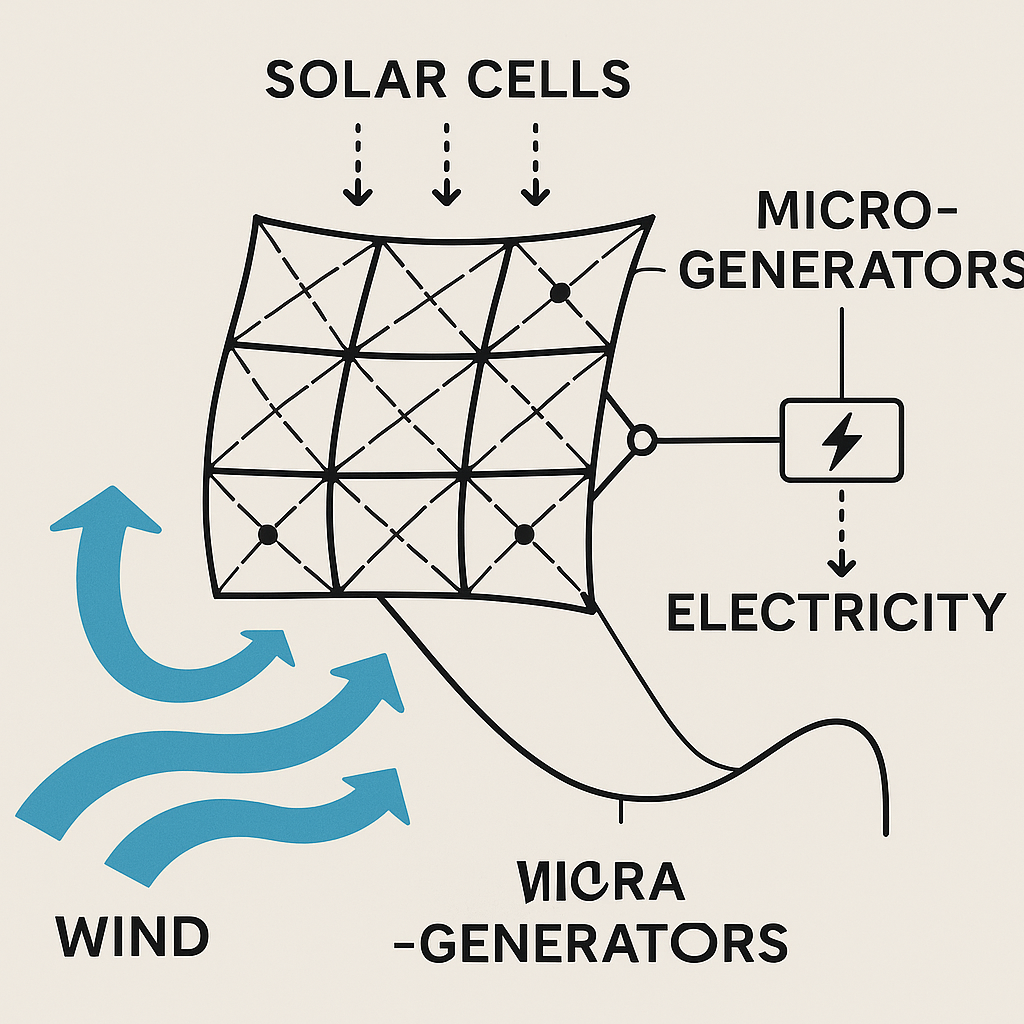
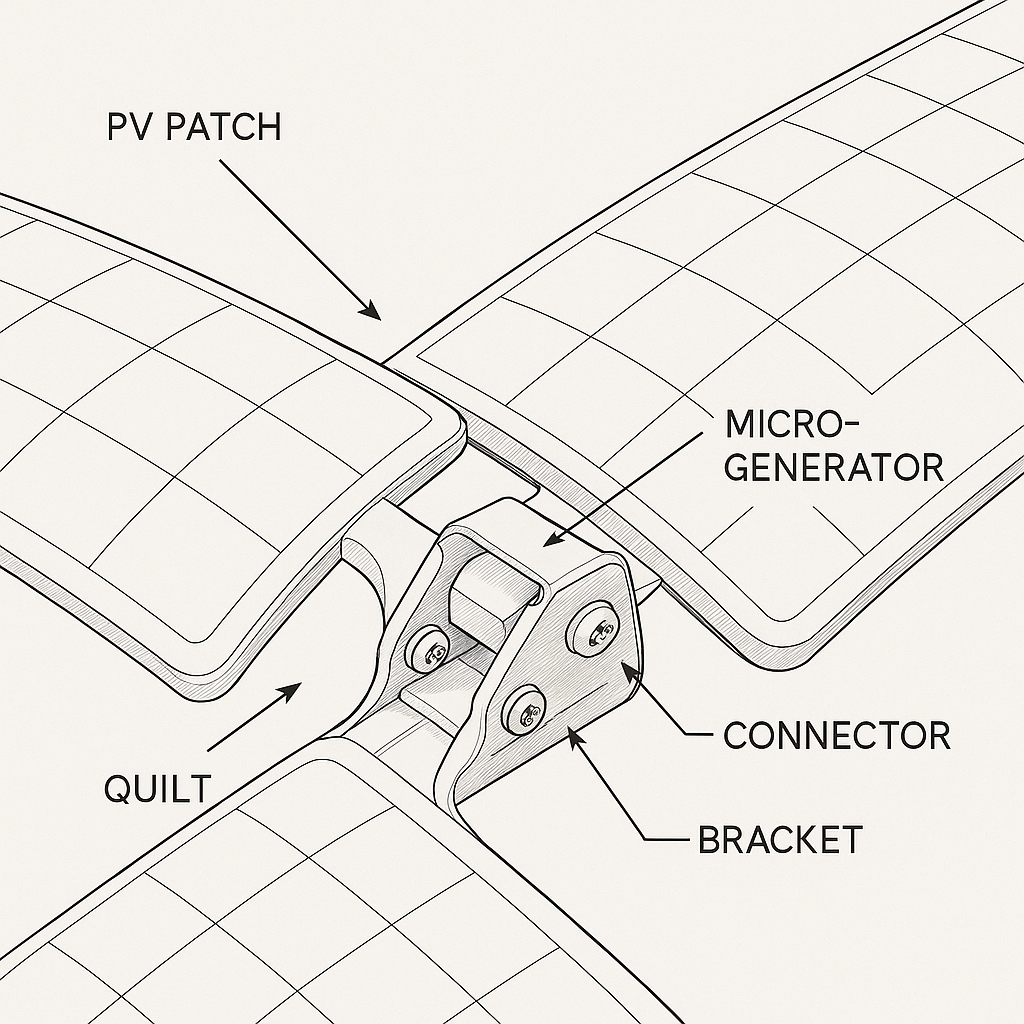
The seams between the quilt patches house motion-sensitive generators, which convert flexion, tension, or vibration into electricity. These seams may use:
- Piezoelectric films
- Triboelectric layers
- Magneto-inductive coils
When the sail flutters in the wind, swells on the ocean, or sways from structural movement, these seams produce kinetic energy, making the sail active even in low-sunlight conditions.
This dual-source generation—sunlight + motion—is what differentiates the system from traditional photovoltaic panels or single-mode generators. The seams are not passive joints; they are conduits of conversion.
3.3 Micro-Storage Nodes
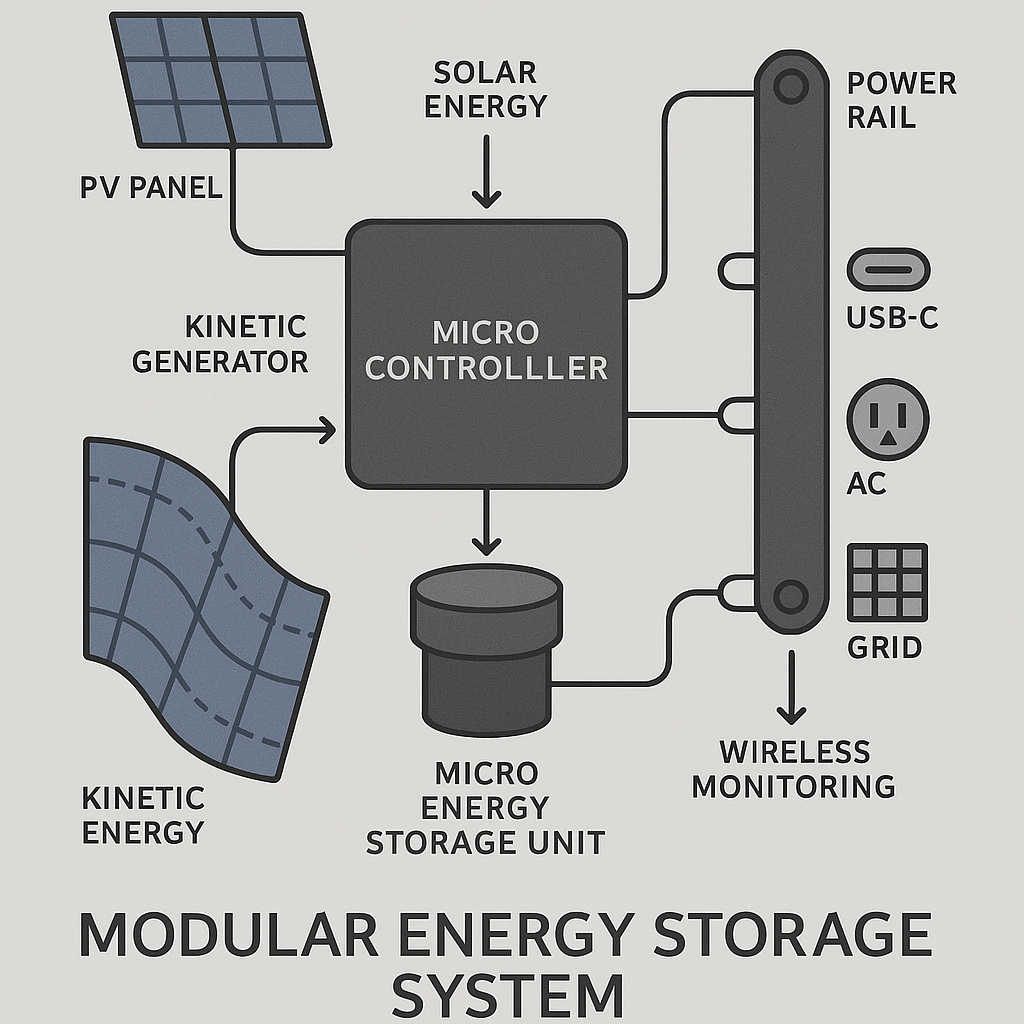
Where patches and seams meet, energy node clusters manage:
- Energy capture
- Temporary storage
- Inter-module distribution
Each node integrates:
- A supercapacitor (for fast kinetic energy bursts)
- A LiFePO4 battery (for stable solar energy storage)
- A microcontroller (for smart routing, diagnostics, and external output)
These nodes function like biological capillaries—transmitting energy fluidly from one part of the sail to another or into a central distribution unit. They may also include USB-C ports, wireless transfer coils, or data sensors.
3.4 Deployment and Structural Integration
The system is deployable in several forms:
- Tensioned sails on vessels or scaffolds
- Laid-flat surfaces across the ocean or terrain
- Curtain-like façades on buildings
- Coiled kits for mobile or disaster response
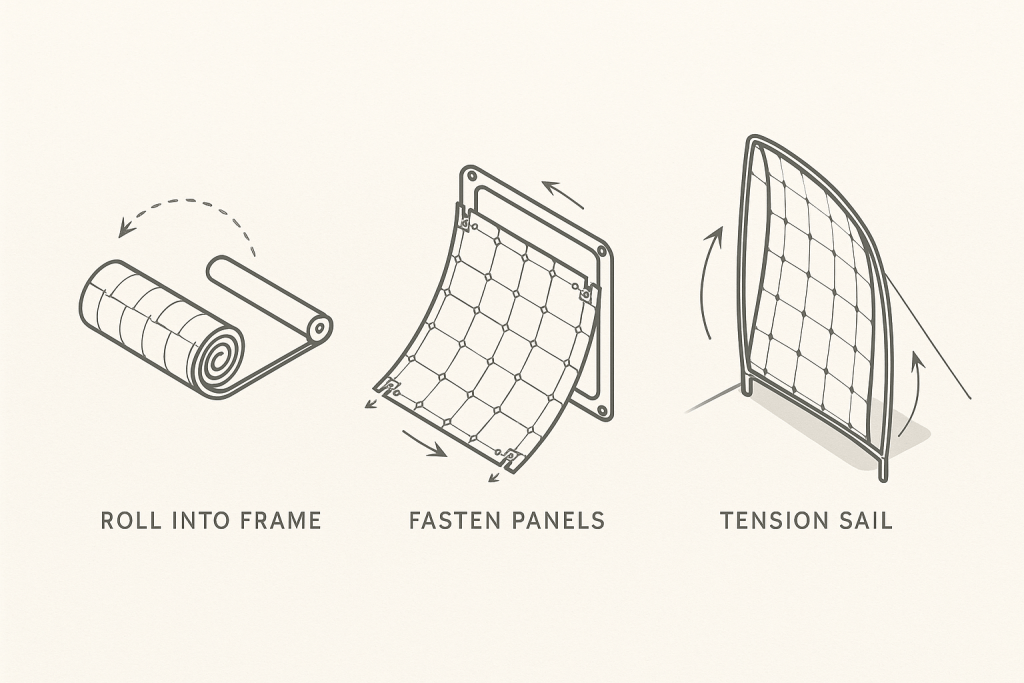
Deployment methods include:
- Rollable frames
- Snap-in seams
- Inflatable substructures
The entire structure is scalable, tool-optional, and highly adaptive—able to conform to a range of spatial, climatic, and cultural conditions.
Summary
By integrating photovoltaic collection, kinetic conversion, modular storage, and adaptive deployment into a single soft infrastructure, the Kinetic Sail Generator embodies a shift in how we think about energy generation: not as hardware, but as responsive textile—lightweight, intelligent, and alive.
4. Use Case Scenarios
The modularity and multisurface adaptability of the Kinetic Sail Generator enable a wide range of applications—from humanitarian infrastructure and ecological restoration to luxury maritime and architectural integration. This section outlines several key deployment contexts, demonstrating the system’s flexibility and transformative potential.
4.1 Maritime Application: Sails and Yachts
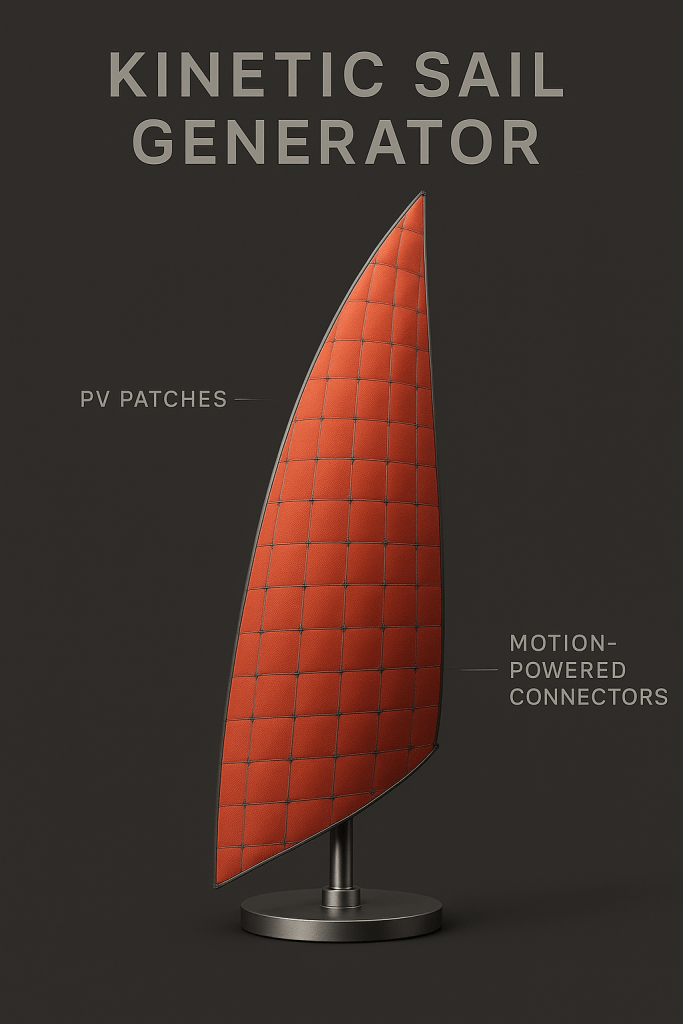
The system’s sail-like form makes it uniquely suited for maritime deployment. Mounted on catamarans, cargo ships, research vessels, or luxury yachts, the Kinetic Sail Generator not only contributes to propulsion (in traditional wind-assisted fashion) but also generates electricity from:
- Solar exposure during daylight cruising
- Wind-induced flutter while in motion
- Swaying or vibration during docking or anchorage
This enables vessels to reduce dependence on diesel generators, increase operational autonomy, and enhance sustainability branding. The generator can be integrated into existing sail rigs or installed as a secondary energy curtain.
4.2 Ocean Surface Arrays
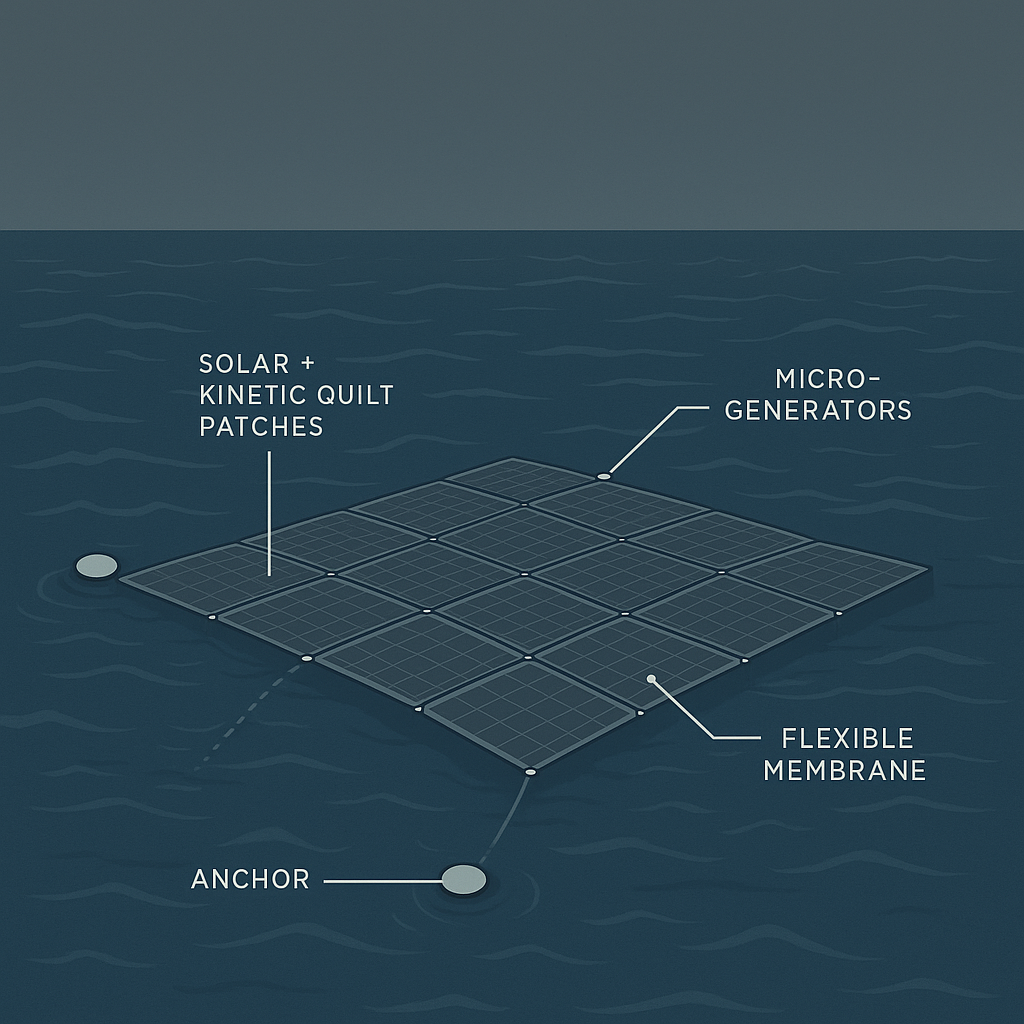
As a floating membrane, the generator can be deployed across calm or moderate oceanic zones to harvest wave motion and solar energy simultaneously. Ideal for:
- Island microgrids
- Marine research stations
- Emergency ocean survival kits
- Climate data buoys
This floating configuration, known as the Ocean Quilt, offers a non-invasive alternative to offshore turbines—quiet, low-profile, and marine-life compatible.
4.3 Architectural Integration: Façade Skins
In urban contexts, the generator functions as a kinetic photovoltaic façade. Mounted as a second skin over buildings, it harvests:
- Solar energy from daily exposure
- Kinetic energy from wind-induced movement and façade sway
Architecturally, it offers a visually expressive, shimmering exterior—a moving, living surface that signals ecological awareness. Perfect for:
- Civic buildings
- University pavilions
- Museums and cultural centers
- Eco-tech campuses
This façade installation can tie directly into building power systems or operate independently as a microgrid.
4.4 Emergency and Expeditionary Structures
Due to its rollability, modularity, and no-tool setup, the Kinetic Sail Generator excels in temporary and deployable shelter contexts, including:
- Post-disaster field hospitals
- Military forward bases
- Nomadic artist pavilions
- Remote research installations
Its power can support lighting, communication, refrigeration, and filtration systems—without fossil fuel dependence. It packs small, sets up fast, and functions even when cloudy, windy, or unanchored.
4.5 Space and Extraterrestrial Infrastructure
The lightweight, vacuum-compatible material logic also enables future deployment in extraterrestrial environments:
- Tensioned solar sails for space probes
- Surface membranes on lunar or Martian habitats
- Energy skins for inflatable space architecture
Its ability to generate power from motion, light, and structure offers redundancy and resilience in space-based systems.
Summary
Whether spanning ocean currents, breathing over a building, or unfurling in the wake of disaster, the Kinetic Sail Generator embodies a new paradigm: infrastructure that adapts, moves, and responds. It is not bound to one place, material, or function—it is a flexible organism of energy stewardship.
5. Technical Innovations
The Kinetic Sail Generator is not merely a conceptual device—it introduces a suite of novel technical systems that reimagine how energy is captured, stored, and distributed in dynamic environments. These innovations occur at multiple scales: from the micro-seam level to the full architectural skin. This section outlines the core mechanisms and the engineering logic behind them.
5.1 Seam-Based Kinetic Micro-Generation
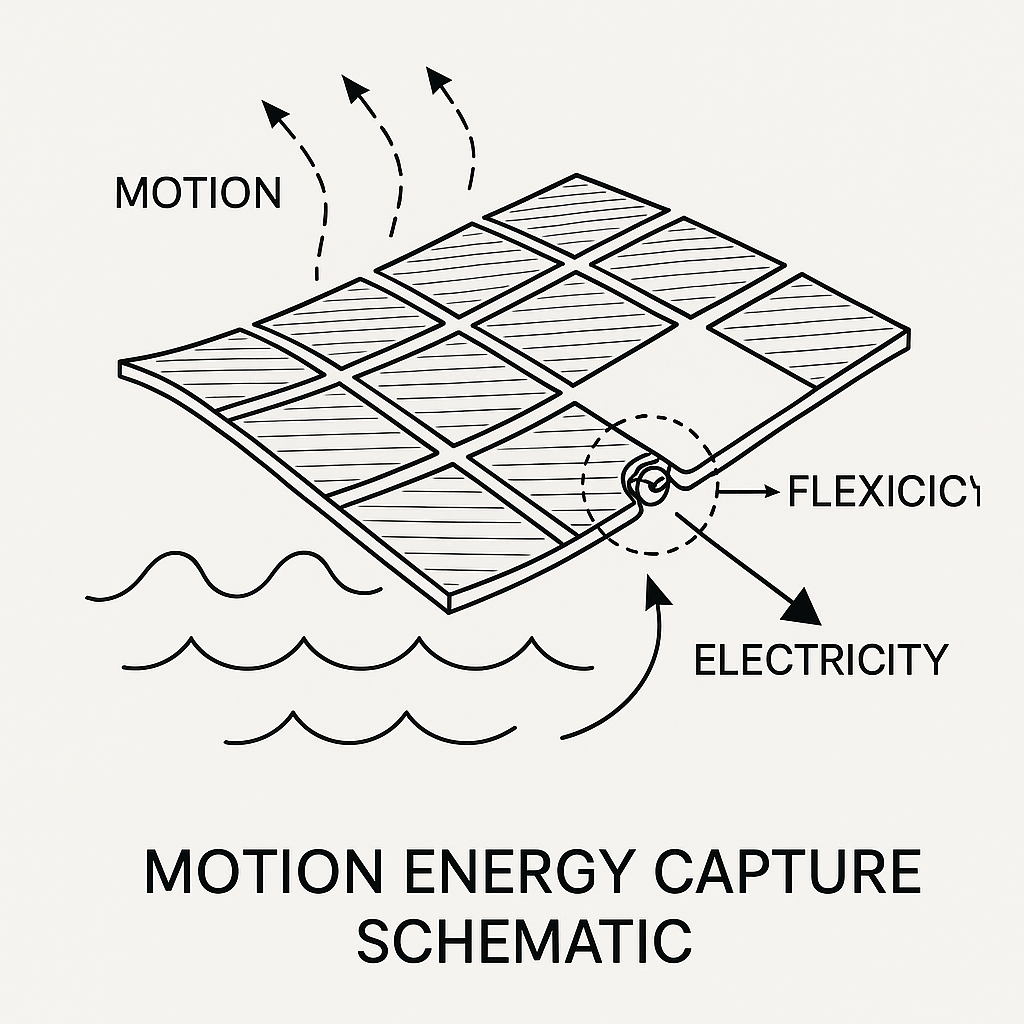
At the heart of the system lies a distributed generator grid embedded within the seams between photovoltaic patches. These seams are engineered to convert motion into electrical current using:
- Piezoelectric films that generate voltage from bending or compression
- Triboelectric interfaces that create charge from surface friction
- Inductive microcoils that capture energy from vibrational magnetic flux
Each seam functions as a flexion-reactive energy strip, meaning that as the sail is affected by wind, water, or movement, it becomes an energy-generating surface.
Diagram Reference: “Seam Generator Cutaway”—illustrating layered construction and conductive routing pathways.
5.2 Node-Level Storage Architecture
Where seams and patches intersect, the system features micro energy storage nodes. Each node contains:
- A supercapacitor for immediate kinetic energy buffering
- A LiFePO4 micro-battery for longer-term solar energy storage
- A microcontroller for power routing, diagnostics, and optional sensor data
These nodes behave like biological capillaries—localized power hubs that also serve as data and structural anchors. The modularity allows for redundancy and fail-safe operation.
Table Reference: “Modular Storage Comparison Table”—comparing energy densities, lifespans, and use cases for supercapacitors and micro-batteries.
5.3 Exploded Axonometric Architecture
The system is designed with modular construction and repairability in mind. An exploded axonometric drawing details the hierarchy:
- Outer membrane – weatherproof PV fabric
- Seam channels – embedded kinetic elements
- Node ring – power capture + control
- Support layer – optional inflatable or tensioned frame
- Output interface – plug-in port or wireless transmitter
This layered design reflects a commitment to scalable manufacturing, ease of assembly, and field-serviceable components.
Diagram Reference: “Exploded System Axonometric”—revealing the anatomy of a single energy tile and its relation to the full membrane.
5.4 Deployment & Tensioning Mechanism
Innovations extend to how the system is deployed and activated:
- Rollable sail kits allow for compact transport
- Snap-flex interlock seams provide quick, tool-free assembly
- Tensioning spines or inflatable frames adjust for environmental conditions
- Self-aligning magnetic edge guides enable seamless energy chaining
Deployment can be performed by a single person in minutes, or scaled across massive surfaces via rail or rig systems.
Diagram Reference: “Three-Step Deployment Sequence”—showing transition from coiled kit to active sail skin.
5.5 Multi-Modal Energy Collection
Most energy systems are limited to a single source (e.g., sun or wind). The Kinetic Sail Generator is engineered for simultaneous multi-modal harvesting, with circuitry designed to:
- Prioritize kinetic energy during wind/swell events
- Shift to solar priority during still, sunlit conditions
- Regulate mixed charging without overload
This intelligence positions the system as a soft grid—self-balancing and adaptive.
Summary
Each technical component of the Kinetic Sail Generator reinforces a unified principle: that energy systems should adapt to movement, weather, and use—not the other way around. Through innovations in seams, nodes, structure, and deployment, this system lays the groundwork for a new era of energy-integrated design.
6. Implications
The Kinetic Sail Generator is more than a technical apparatus—it represents a paradigm shift in how we understand and relate to infrastructure. It repositions energy generation not as an isolated process, but as a responsive, embedded, and culturally expressive system. This section explores the broader implications of the invention across ecological, architectural, and societal dimensions.
6.1 Decentralized, Human-Scale Energy Futures
In a world increasingly threatened by the volatility of climate change, global conflict, and fragile centralized systems, the Kinetic Sail Generator offers an infrastructure rooted in resilience and redundancy. It democratizes energy access through:
- Node-level autonomy (each segment operates semi-independently)
- Ease of transport and assembly (by non-experts in the field)
- Compatibility with nomadic, rural, or disaster scenarios
This enables communities to generate power without grid dependence, empowering a new class of energy citizenship—flexible, mobile, and self-determined.
6.2 Cultural Symbolism and Architectural Expression
Unlike conventional energy infrastructure—which is often hidden, utilitarian, and sterile—the Kinetic Sail Generator is intentionally visible and kinetic. It moves with wind, shimmers in light, and signals its presence as a ritual object as much as a functional one.
Architecturally, it becomes:
- A symbol of sustainability
- A living façade that animates public buildings
- A visual narrative about our relationship with environment and motion
This reflects a shift toward poetic infrastructure—where systems not only perform, but also mean something.
6.3 Integration with Environmental Intelligence
The sail’s smart nodes and sensor-ready circuits also open the door to real-time environmental feedback loops. With minimal additional components, it can:
- Monitor humidity, salinity, sunlight, and wind speed
- Report on system health and local climate conditions
- Inform adaptive behaviors in connected architecture or systems
This aligns with eco-feedback design, where environments respond to themselves—and to us—in a mutual learning loop.
6.4 Toward Living Infrastructure
Most critically, the Kinetic Sail Generator advances a theory of living infrastructure:
A system that moves, feels, and adapts—not unlike a body.
A system that is deployed, retracted, stretched, patched—not built once, but cared for continuously.
In this way, it calls for a new architectural ethic—one that is humble, responsive, and coexistent with natural rhythms. The sail becomes a metaphor for civilization that doesn’t conquer, but cohabits.
Summary
As both an energy system and a design philosophy, the Kinetic Sail Generator challenges the boundaries between technology and ecology, engineering and expression, function and ritual. It is not just a way to generate electricity—but a way to rethink our relationship to energy, architecture, and adaptation.
7. Conclusion
The Kinetic Sail Generator represents a fundamental rethinking of how, where, and why we generate power. By merging photovoltaic textiles, kinetic seam converters, and modular micro-storage, it forms a living energy skin—flexible, adaptive, and expressive. This technology is not bound to one typology; rather, it exists across domains: as architecture, marine infrastructure, wearable membrane, and ecological interface.
As climate volatility accelerates, the need for mobile, redundant, and user-centered energy systems becomes urgent. The Kinetic Sail Generator meets this challenge not by scaling up, but by scaling differently—by creating systems that are lightweight yet resilient, poetic yet performative, and deeply embedded in the conditions they inhabit.
This invention contributes a new vocabulary to infrastructure: one rooted in motion, breath, and modular interdependence. It expands the field of architecture toward material intelligence and the field of energy design toward soft autonomy. As an innovation, it invites technical development. As a concept, it invites cultural adoption.
Next Steps
The provisional patent, filed May 8, 2025, secures the intellectual basis for prototyping, licensing, and testing. Ongoing work includes:
- Field deployment simulations
- Prototype seam and node module fabrication
- Partnership outreach with marine, defense, and architecture sectors
- Integration with smart sensor and wireless energy networks
The Kinetic Sail Generator is not a product. It is a membrane for the future—light enough to float, strong enough to endure, and intelligent enough to adapt.
A provisional patent was filed with the United States Patent and Trademark Office (USPTO) on May 8, 2025, under the title Kinetic Modular Energy Skin for Multisurface Power Harvesting. The invention is currently patent pending under U.S. Provisional Application law (35 U.S.C. § 111(b)).



Leave a Reply