
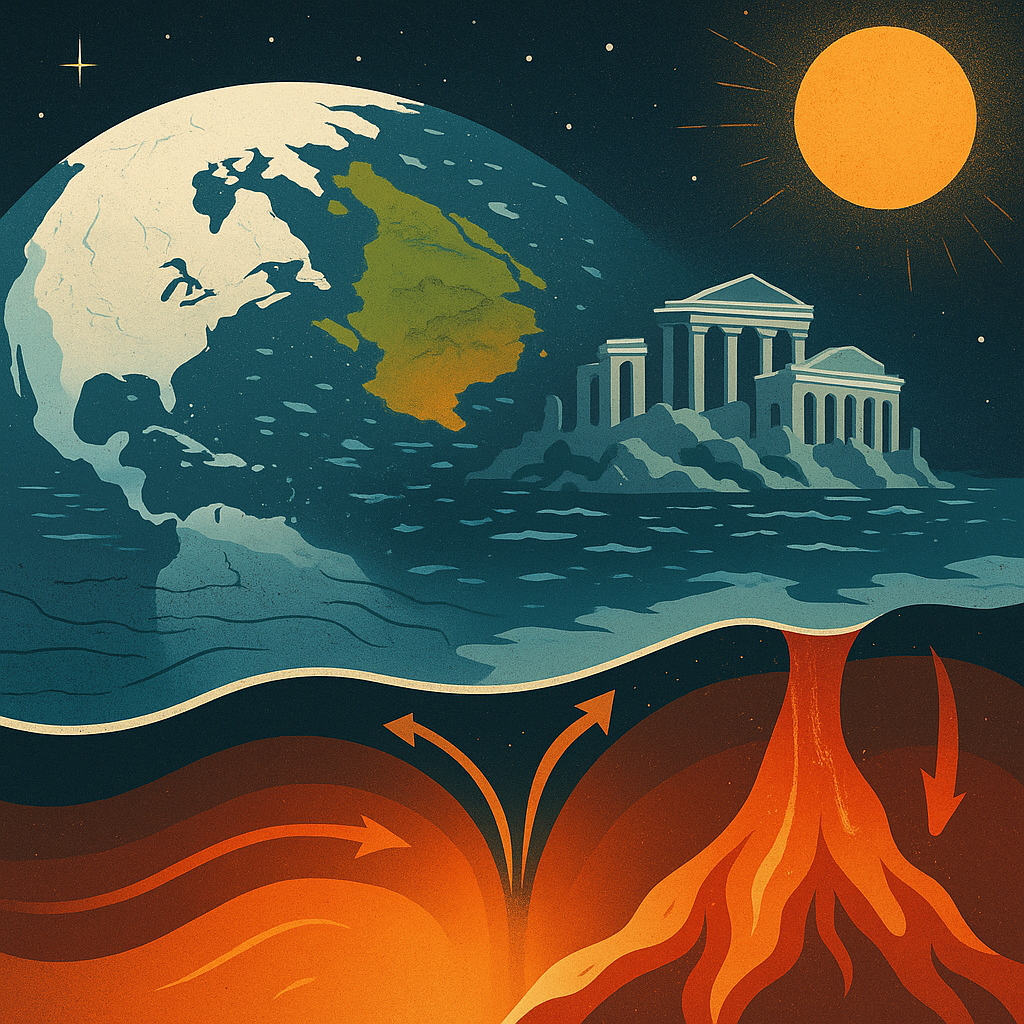
What if climate change isn’t just the result of human activity… but of Earth’s own restless movement? What if the myth of Atlantis was the memory of such a shift?
Introduction:
The prevailing view of climate change is that it’s primarily driven by human-caused greenhouse gas emissions. But what if that’s only part of the truth — or a surface-level interpretation of a much deeper process?
This essay proposes a planetary reframing: that Earth’s crust is not fixed, but drifts across a fluidic, thermally uneven substrate. As it does, entire continents — including the polar caps — can move over “hot spots” or “cold zones” in the Earth’s underlying mantle. This crustal migration could explain sudden warming events, ice melt, sea level rise, and even the sudden disappearance of civilizations — including the legendary Atlantis.
The Crustal Migration Hypothesis:
Earth’s outer shell — the lithosphere — floats atop the asthenosphere, a softer, partially molten layer. This dynamic foundation is not evenly heated. It contains hot zones, where geothermal heat escapes, and cold zones, where the crust is more thermally insulated.
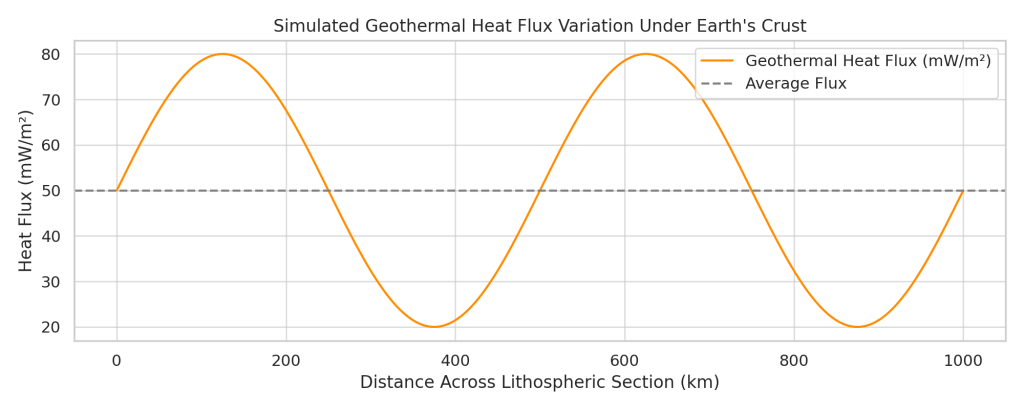
Figure 1 – Simulated variation in geothermal heat flux beneath Earth’s crust. Hotspots and cold zones may influence surface climate by melting ice caps from below.
As tectonic plates migrate:
A polar ice mass may drift over a hot zone, triggering accelerated melting and coastal flooding. Conversely, a temperate landmass may shift into a colder zone, becoming more glaciated.
This suggests climate is not solely regulated from above (by the atmosphere), but also from below — by where the crust happens to be floating.
A New Lens for Atlantis:
Plato’s account of Atlantis describes a thriving civilization that sank beneath the ocean “in a single day and night.” Mainstream science dismisses this as myth. But what if Atlantis was real — and was simply a landmass that experienced:
A sudden crustal shift A rapid melting event from geologic heat exposure Tectonic subsidence due to crustal redistribution
This could have caused flooding, land collapse, and the preservation of a myth passed down as warning, not fantasy.
Empirical Evidence That Supports This:
1. Geothermal Hot Spot Beneath Antarctica
NASA’s Jet Propulsion Laboratory (Seroussi et al., 2017) confirmed a large heat source beneath the West Antarctic Ice Sheet — potentially melting it from below. This aligns with the idea of crustal repositioning over heat zones.
2. Earth Crust Displacement Theory
First proposed by Charles Hapgood and supported in correspondence by Einstein, this theory suggests the entire crust can “slip” over the mantle — rapidly changing pole positions and climate zones.
3. Submerged Cities and Megastructures
Sites like Yonaguni (Japan), Dwarka (India), and Bimini Road (Caribbean) show evidence of submerged megalithic ruins, suggesting large-scale, ancient sea-level changes.
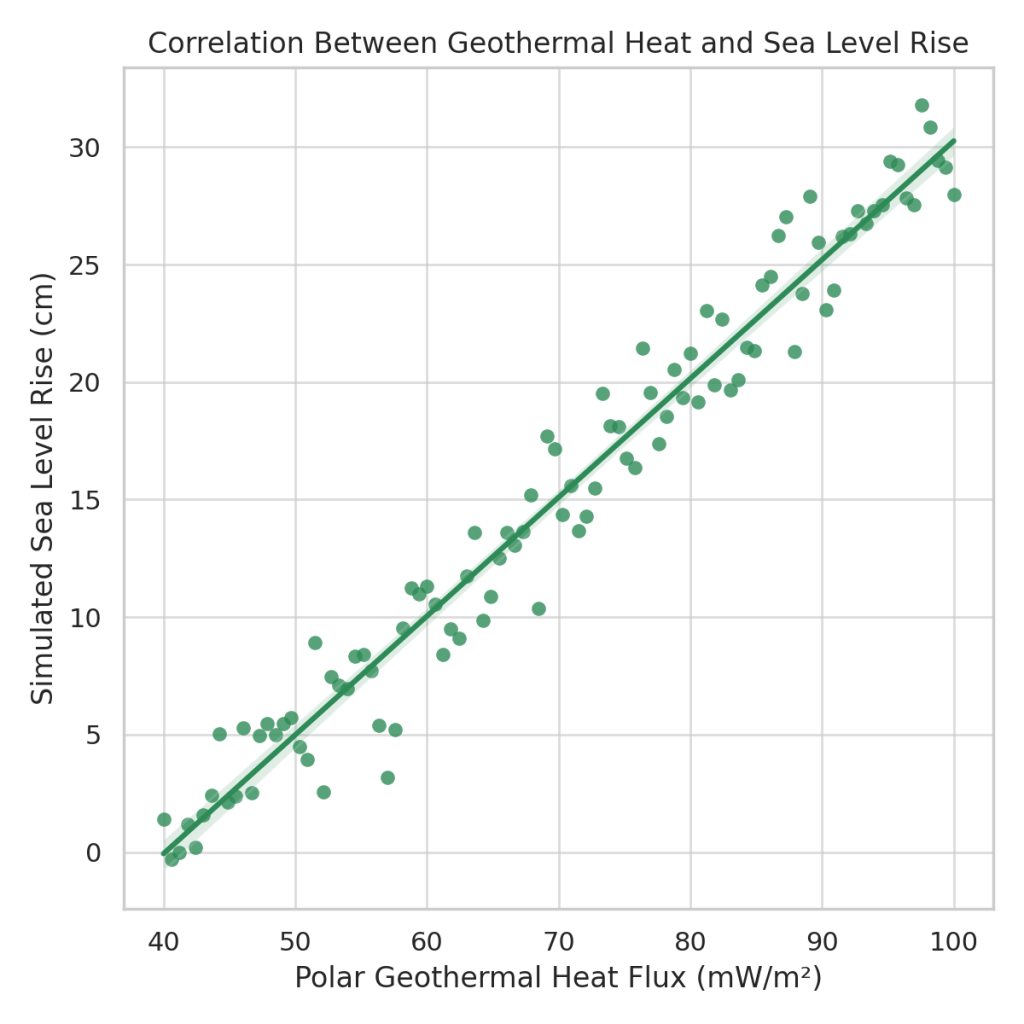
Figure 3 – Hypothetical correlation between elevated polar geothermal heat and rising sea levels. Increased basal melting may accelerate coastal submersion.
4. Abrupt Climate Shifts in Ice Cores
Greenland and Antarctic ice cores reveal rapid temperature swings occurring over mere decades — impossible to explain by gradual CO₂ rise alone. Crustal realignment may be a missing factor.
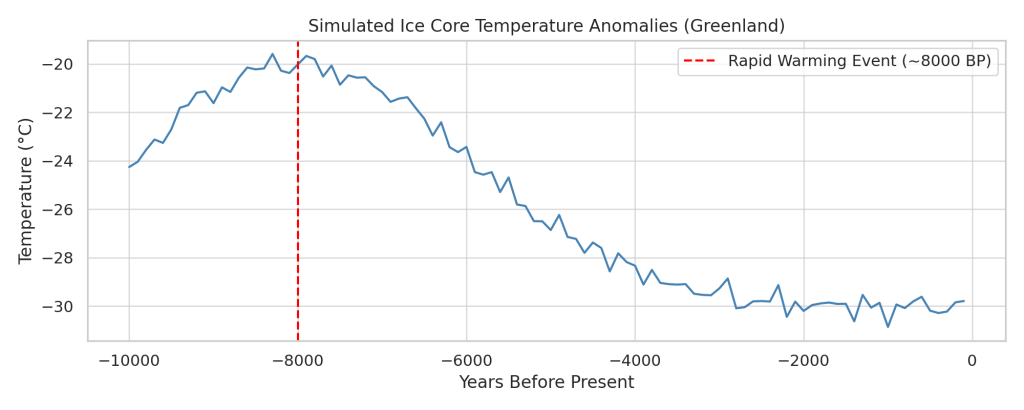
Figure 2 – Ice core records showing a sudden warming event around 8,000 years ago. Such shifts may correlate with crustal movement over geothermal regions.
Philosophical Implications:
If this model holds weight, then “climate change” is not just a consequence of human error — it’s part of Earth’s cyclical, field-based reorientation. Humanity may be witnessing not a linear crisis, but a phase transition — one that repeats across ages.
We may not be destroying the Earth, but awakening during one of her shifts.
Call to Action
If this resonates — share it, question it, or explore it. Atlantis may not be lost, just misunderstood. And climate may not be just a change, but a movement.
Written by: Charles LaVell Scott – MArch., MBA
Founder, Lambda Field Dynamics Institute (LFDI)
Leave a Reply